
Rksv business model analysis

RKSV: The Discount Brokerage Firm For The Beginners!

Giving traditional brokers, a run for their money!

What is ‘RKSV’? What Is Their Business Model?

Headquartered in Mumbai – RKSV is a discount brokerage firm that holds memberships with the NSE (National Stock Exchange), BSE (Bombay Stock Exchange), MCX (Multi Commodity Exchange), and MCX-SX (Multi Commodity Exchange Stock Exchange).

Certified by the Securities and Exchange Board of India (SEBI), RKSV helps retail investors and institutional corporations to invest in stocks, options, futures, commodities and currencies at rates comparatively lower than the traditional full-service brokers.

The company was founded in 2012, and as of today it accounts for a Daily Transaction Volume worth Rs. 6,000 crores, which is almost 2-5% of the total turnover on the NSE.

So what’s so different about them?

Well, as we all know, when you trade in the stock markets, it is not for free, there is a commission that you have to pay the broker along with a small amount for the actual transaction.

Now one of their USP’s is that – while, the traditional full-service brokers charge a percentage of the total value of your trade as brokerage commission, RKSV charges flat fees and Zero Brokerage, helping you to significantly cut the costs.

In order to execute this zero brokerage fee idea, RKSV has opted for an online-only business model. Unlike other brokerage firms who have hundreds and thousands of branches spread across the country, RKSV has one central branch in Mumbai, and operates through the internet; thus, keeping their operational costs to a minimum.

Other than that, they have also imbibed advanced charting tools and risk management systems protocols to make sure that their customers get to experience the best trading platform on platforms including – Desktop, Mobile and Tablet.

Unlike other brokers RKSV also develops their trading tools in-house, which helps customers to make more informed trading decisions. These include – Brokerage Calculator, Span Calculator, Options Strategy Builder and Global Data Feeds Plugin (GDFL).

Safety of the funds at all times is the top most priority of RKSV, and they take every measure to ensure that client funds are kept secured and segregated at all times.

RKSV has also introduced their educational arm called – Trade Academy! Trade Academy is a free educational portal initiated with a purpose to educate first time users who want to learn and understand the nuances of trading, more specifically, equity & derivatives markets.

More recently, RKSV has also introduced Upstox to their package. Upstox is a mobile app initiated with a purpose to simplify the world of investing and trading for both professional traders and beginners. Its features include charting indicators, margin trading, margin against shares, and zero brokerage trades on Equity stocks for delivery.

How Does It Work?

RKSV offers 4 different types of accounts: –

  1. Individual Accounts
  2. HUF “Hindu United Family” Account
  3. Partnership Account
  4. MCX/Commodities Accounts

To begin trading with RKSV one needs to create an account with them, which usually takes somewhere around 1-2 working days. All one needs to do is: –

  • Fill and submit their KYC (Know Your Customer) form. According to Securities and Exchange Board of India (SEBI), every broker is required to verify the details of their customers, which also includes conducting an In-person Verification (IPV). RKSV conducts IPV process over the web.
  • Provide two cheques
  • And lastly, provide three identification proofs

For any clarifications, one can also call their customer support desk as well at +91-22-6130-9999.

What are their Market Segment, Revenue Model & Strategies?

Currently, not more than 1.5 – 2.0 % of the Indian population actively participates in the trading on the capital markets. This is mainly due to difficulties that surround the sector, such as – high brokerage costs, difficult-to-understand trading software, and poor customer support.

With their state-of-the-art technology, industry expertise and zero brokerage business model, RKSV aims to target this pain-point and bridge this huge gap.

To help this market – unlike its peers, RKSV has introduced a Zero Brokerage plan where they charge Flat Fees, along with an easy to understand pricing plan. One can either pay Rs 20 per trade or a monthly fee of just Rs. 1947 (Unlimited Trading Plan), to use their service.

Talking about their Strategies – RKSV’s business model itself is the best strategy adopted by them!

If you look at it; they offer an ‘unlimited trading model’, where traders can transact for as many times that too at a fixed cost. Plus, since RKSV is a completely online algorithm-based business model, they do not require any relationship managers, advisors, or for that matter, multiple office space as well.

Using these basic strategies itself, RKSV saves a lot of costs, which they in turn pass on to the customers, in the form of low fees.

Yes, it is true that clients require advice too, and for that, RKSV has adopted the system that is followed in the US and Europe, where people don’t take advises from the brokers, but instead, they have softwares that are equipped enough to tell you what to do to enable you to trade efficiently.

Additionally, they also offer top notch Customer Support; wherein, whenever customers ask questions through their ticketing system, their queries get resolved promptly.

Basically, all they do is they connect their customers with the right kind of tools that are required to trade, along with good customer support.

Other than that, the company solely relies on ‘Word of mouth referrals’ for their marketing. They believe that it is the best way to grow a business, and also avoids unnecessary marketing costs too.

Who are the Founders?

RKSV was founded by by Raghu Kumar, Ravi Kumar and Shrinivas Viswanath in 2009, who collectively manage a team of approx 100 employees! The full form of company name – RKSV is the initials of the names of the cofounders.

  • Raghu Kumar & Ravi Kumar

Born in India and brought up in the US, the brother duo – Raghu Kumar & Ravi Kumar have always been intrigued about entrepreneurship.

While, Raghu holds a Bachelors of Science degree with a specialization in Actuarial Science & Finance, Ravi has completed his Bachelor of Science in Information and Computer Science.

Raghu had first gained his passion for trading at the age of 16, when a teacher in his school had organized a competition, wherein all the students were asked to invest in stocks and the best portfolio would get some credit.

The credit for Raghu’s inclination towards trading can also be given to his brother Ravi as well. If it would have been for Ravi’s 2 year stint at ‘Thinkorswim’ in 2004, or if Ravi wouldn’t have begun trading in penny stocks, Raghu wouldn’t have gotten so intrigued.

The decision of Ravi to join a broking firm is said to be the turning point for the brothers. It was only after Ravi joined, that Raghu began taking interest in the Forex Markets.

In 2006, the brothers had started RK Trading to develop trading models for a proprietary trading firm. Raghu wrote Algorithms, while Ravi coded them.

Proprietary trading is something wherein, a particular firm trades for themselves and with their own money, and RK Trading used to make algorithms that traded automatically according to market conditions with an end goal of making more profits.

Post this stint and after the Market Crash of 2008, they came back to India and started RKSV, along with Shrinivas.

Presently at RKSV, Raghu is considered to be the most critical and integral part because of the multiple roles he plays. Mainly, he writes algorithms for proprietary trading, works with the business, customer relations & media communications teams. Due to his analytical mind Raghu is also considered to be a problem solver by many!

  • Shrinivas Viswanath

Shrinivas is the third cofounder of RKSV.

He completed his Bachelors in Computer Science from the University of Illinois, and began his career in 2005 with Cerner Corporation as a Software Engineer. Post this 3 month stint, he also worked with Morgan Stanley as a Technology Analyst, and then Citi as a Business Intelligence Delivery Manager for 3 months and 9 months, respectively.

While at Citi, he was further promoted to Solutions Architect / Program Manager and then Program Manager as well, after which, he cofounded RKSV in 2009.

What is Their Story? How Has Their Growth Been So Far?

Although, RKSV has managed to attain success in a short span, but their struggles remain unusually timeless.

So before coming to India; Raghu and Ravi had started a proprietary trading firm called RK Trading, and for the next two years, everything that they touched, turned gold. They made a killing of roughly $20 million in the US and the European markets.

But unfortunately, in 2008, Global Markets crashed! While the world was under huge crisis, recession had hit them really hard too. The trading opportunities had dried up & liquidity had shrunk to zero.

It was time for them to change their course of action. So for the next one month, they kept all the options open and rigorously began their search!

At that point; they saw the Indian market and noticed that India was making way for Direct Market Access (DMA), due to which, the institutional investors would be able to gain direct access to the market; in other words, no more broker compulsion!

Since, the Western markets had reached to a saturation point, they along with Shrinivas decided to come back to India.

Soon after the necessary research was complete, they applied for a BSE membership and also shifted their base to Mumbai. Here, they also managed to convince a broker to allow them to trade via his infrastructure through a profit-sharing arrangement, and began trading as well.

Around the same time; they came to know that BSE was keen on enrolling new members and had cut down their membership fees from Rs. 1 crore to Rs. 10lakhs as well. Hence, Raghu met Balasubramaniam V (Chief Business Officer – BSE) and got their BSE membership.

With that in place, in 2009, they launched their first company in India – RKSV!

Initially, they started with proprietary trading; wherein they only traded for themselves and made about Rs. 24 crores in about three years.

While at it, Raghu noticed that realized that brokerage costs were killing the traders and they literally didn’t have any option but to agree to the given terms. Other than that, he also noticed that the retail brokers held multiple offices in just one city; thus, increasing the costs massively.

Hopping on to the presented opportunity, in 2011, RKSV entered the stock broking market with an Online-only Business Model and Zero Brokerage plan.

And since then; their numbers spoke for the company!

In the next two years; even after operating in a dull market, the company with a team of just 80 members was clocking a daily transaction volume of Rs. 4,000 crores from about 20,000 clients, which then was about 1.3% of total turnover of NSE.

Further, they also raised $4 million from Kalaari Capital, GVK Davix and others, and also launched a full suite of products for Upstox as well.

Today, they operate with a team of about 100 employees, are clocking Daily Transaction Volume of Rs. 6000 crores, and would also be touching Rs. 10,000 crores by the end of the year as well. This would make up around 3-5% of the NSE’s turnover.

After RKSV has reached a certain size, they also wish to enter into sports by entering the field of Saber-metrics, the experiential analysis of baseball statistics.
haptik business analysis

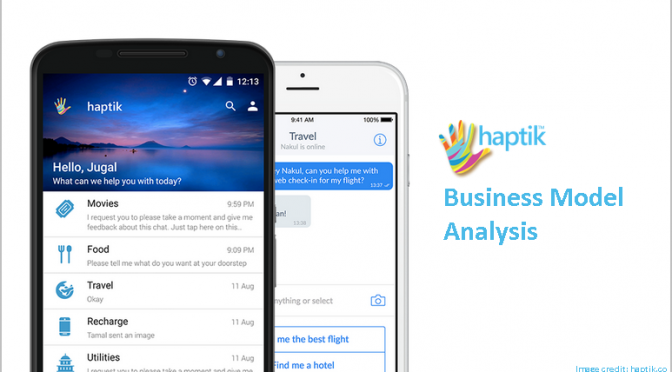
Haptik – All-Round Personal Assistant

Be it – Searching for Information, Completing a Task, Setting a Reminder, Placing an order, or anything else – Haptik is your All-Round Personal Assistant!

What is Haptik.co? What is their Business Model?

Haptik is a mobile messaging assistant for information and support that was founded by Aakrit Vaish and Swapan Rajdev in 2013 and is registered in San Francisco.

It was founded with a goal of making Customer Service more approachable and is based on a Customer Support / User to Business Messaging model.

Haptik is like normal text messaging that enables one to chat with experts for any query related to any company or service.

As a user of Haptik, one gets to leverage a one-point access for majorly all queries, to almost 200 companies and brands such as – telecom, cable services, automobile, shopping, airlines, banks and others sectors across 13 categories.

Since text communication is the most used medium than any other application on our phones, Haptik acts as a Personal Assistant to help you complete the lesser important tasks through a chat-based module.

Be it – searching for information, completing a task or buying/ordering anything, their Assistants are trained across various verticals to help you get your work done within an average response time of 5 minutes.

How does Haptik Assistant works?

  1. Install the app and choose the company from the list of companies, your query is concerned towards.
  2.  You can either choose from a predefined set of questions or write their unique question to Haptik representative, and accordingly, the Expert on the other side gets the Chat.
  3. Be sure that, their experts have immense knowledge about the given topics. They go through complete training and are also embedded with unique mechanisms at the backend to help the customers as well.
  4. And if the query is beyond the reach of the Experts, then in such cases, the Expert reaches out to the concerned company itself, on behalf of the user, and would also keep the customer in the loop.
  5. Lastly, when the issue is resolved, the chat is considered complete.

Other than company-specific queries, Haptik also offers other generalised services such as: – Searching the best Mobile plan, Cable/ DTH plan, etc, Troubleshooting of Phone or Computer, Car/Bike prices search, Coupon Search, Movie Timings, Finding the nearest ATM, Restaurant Reservation, Tracking of Online Order Status, Web Check In, Search for a Rental Flat, File a Complaint, and many more…!

How are the Experts selected?

Well, to become a Haptik representative, there are certain criteria’s that one must meet.

  1. Bachelor’s Degree.
  2. Excellent and Quick Problem Solving Skills
  3. An Excellent command over English language
  4. Apart from these, having skills in a particular category among the various ones listed on Haptik, adds a few Brownie Points to ones profile

TRIVIA: – The name was chosen after writing about a 100 names on an excel sheet, and then zeroing down on Haptic (which means non-verbal feedback). This was further changed to Haptik from the German translation ‘Happik’.

What Are Their Strategies, Market Segment & Revenue Model?

 Customer Service still remains to be a pain for both the ends – Companies and Customers. A recent research disclosed that, less than 8% of customers believe they have experienced “superior” service from companies, while more than 73% believe otherwise.

On the other end, many users spend an awful lot of time on searching for information on the internet about information such as – services provided by companies, which is even more complicated and painful when done through the mobile.

This is the segment that Haptik is trying to target. Their whole one-stop shop nature layered on top of a messaging interface, not only solves the customer service issue, but at the same time also helps the customers save time by helping them search the information they need.

Haptik has opted for a business model that not only is an unsolved pain-point, but also targets both – Customers and Businesses, and strategically positions them in the market as well.

For the Consumer – Haptik positions itself as a one stop solution for all customer queries, due to which they are relieved from the whole process of different customer care centres. It wants to be the alternate means of communication for consumers which can be dealt at their own pace of time, convince and space.

This is one of the reasons that have greatly helped Haptik to grow fast and win customer’s trust and confidence.

While for the Business / Companies – They are positioning themselves, to become the frontend or the face of the company, which would also take away their pain and help them build their customer base even stronger.

Now all of that has been achieved and their growth has been purely organic. Majorly, they have chosen to grow using the word of mouth publicity than any other medium. Yes, they have performed basic digital marketing to end users using social media, content, press, etc, but the credit for their popularity definitely goes to Word-of-Mouth.

Lastly talking about their revenue model – Haptik charges the businesses to come on board and directly engage with their users, and the pricing is determined by number of messages transacted per company, which again, could be anything from Rs. 25,000/month to Rs. 100,000/month depending on the volume of messages.

Who Are The Founders?

Haptik was founded by Aakrit Vaish (CEO) and Swapan Rajdev (CTO) in 2013, who collectively manage the Management Team which includes: – Ashim Jolly (COO), Raveesh Bhalla (Number 10) and Akhil Aryan (VP, Product & Marketing).

  •  Aakrit Vaish

Currently the CEO of Haptik, Aakrit is also an active investor too. As an investor, Aakrit favourite spots start ups in India are in the areas of ad tech, SaaS and Mobile, and is also on the board of a family run business of home textiles and interiors called – Winmark.

Aakrit has completed his Bachelors in Industrial Engineering from the University of Illinois at Urbana-Champaign.

He started his career with in May 2006 by working for Motorola as a Consumer Engineer for about 4 months, post which he moved on to join Chicago Transit Authority in June 2007 as a Financial Analyst.

This stint lasted for about 3 months, post which, he joined Deloitte Consulting LLP as a Business Technology Analyst in July 2008, and managed to stick around for almost 2 years.

In May 2010, Aakrit moved to Flurry Inc as a Manager of Business Operations and in about a year and a half got promoted to Director of their India operations as well.

After successfully setting up their India office in Mumbai, and after running the show for another 2 years approx, Aakrit decided to become an entrepreneur.

In 2013, he cofounded Flat.to – a real estate platform for college students and bachelors across India!

Now around the time, when he had started Flat.to, he had also begun work on Haptik as well. But turns out, Flat.to didn’t last for long and eventually got sold to CommonFloor.com in April 2014, whereas, Haptik took off!

  • Swapan Rajdev

Swapan is the co-founder and the Chief Technical Officer of Haptik. He and Aakrit have been friends from since the Engineering days at the University of Illinois at Urbana-Champaign.

Swapan began his career as an Intern into Sales and Marketing with IBM in March 2006, post which he also joined Accenture in June 2007 as a Summer Analyst for the next 3 months.

In 2008, Swapan again joined Accenture but this time as a Full-time Consultant in August 2008. After working with them for around 3 years, he moved to join Radius Intelligence in April 2011as a Software Engineer.

In 2010, he had also ventured out into Entrepreneurship with Zing! Apps – that makes native and web based iOS applications, post which he then joined Aakrit to start Haptik.

What Is Their Story? How Has Their Growth Been So Far?

It all began during Aakrit’s days with Flurry!

While at Flurry, he worked alongside with companies like WhatsApp, TextFree, and TextPlus, etc., noticed their high growth and also believed strongly in the potential they held.

As a result, he along with his cofounder Swapan began working on different ideas, and eventually landed to the Eureka moment.

Since, texting was and is the most used form of communication; they decided to create a messaging app for customer support, and began prototyping.

After several attempts, they launched their final product for the market in 2013.

In just about 10 days after the launch, Haptik received a tremendous response, and in the next 18 months with a total of 100,000 and 40% monthly active users, they had managed to become one of the top 25 apps on Android and top 50 on iOS.

They were now providing support for more than 100 brands and had processed more than 45,000 messages on the platform as well. They were now being covered by all the leading publications of the country, and were also getting new inbound inquiries from companies and brands too.

After being self-funded for more than a year, Haptik received more than $1 Million from Kalaari Capital in September 2014.

In the year of 2015 – using these funds, the company brought about some remarkable developments. They launched the 2.0 and 3.0 Version of Haptik, which included some 28 major changes such as a new look that incorporates Google’s Material Design spec, a shortcut menu to frequently asked queries and the ability to add images to messages, along with reduction of all interactions to just two screens, home screen serving as an Inbox, with list of permanent “channels”, etc…

Other than that, by the mid of the year they had also increased their team to 33 individuals and 210 contract workers, had recorded over ​9​00,000 chats since initiation, had grown 10 times in the past six months, and were witnessing over 50,000 users accessing the app at least once a month.

The company was providing their service to companies including DineOut, Mr. HomeCare, CoverFox, CouponDunia, BookMyShow, eCourierz, etc. and had also partnered with Ola to extend their cab booking functionality to Haptik as well.

More recently, they have also begun monetising about 10% of its chats and are seen to be experimenting two revenue streams which include – a customer support engagement channel for brands, and the second making is taking a commission on influencing purchases. Currently, their partners include Amazon, Freecharge, and several more.

Going ahead – Haptik aims to continue their 40% Month-on-Month growth, reach 50% monetisation of their chats in the next few months, and also reach their target of achieving revenues worth Rs. 5 crores for FY15-16.

Voonik

Voonik – The First Ever Personal Styling App In India!

Started in 2013 and based in Bangalore, Voonik is an online personal stylist helping users handpick fashion apparel, and also the fastest growing fashion shopping app in India.

Voonik not only focuses on listing shopping products for women, but also focuses on their style preferences too.

‘Voonik’ is a play on the word ‘Unique’ and they chose this name because, they wanted a neutral name that did not have any association.

Some of their offerings include: – Indian wear, western wear, lingerie & sleepwear, footwear, bags, accessories, jewellery, beauty, special, etc…

How It Works…

  • Sign up with Voonik.com
  • You’ll be asked a few quick questions to understand a number of factors about you, like body type, skin tone, height, etc.
  • Then choose the kind of events that you frequently visit, such as – Casual Social Event, Casual Business, Formal Business Meeting, Sports, Traditional Indian, Religious, Western and many more, to provide you with even more accurate recommendations!
  • Based on your responses, the app offers you an instant personalised style recommendations from stylists for various occasions such as –what will suit you, how to wear them, and what to pair them with, etc…
  • Then there’s also the option of asking their in-house style experts on clothing and fashion tips.

Their business model is very simply to understand – using the power of their technology i.e. machine-based predictions (personalization-on-steroids platform) and the power of expert curation, they are trying to solve a timeless problem: “What should I wear today?”, by imagining how shopping would take place after 20 years.

To take care of the curation part – they use a very light weight business model, and don’t carry inventory or handle deliveries, instead, Voonik gathers about 15 Lakh different products from different merchants, display’s it on their site, and their job is to make sure that each user sees the products she is most likely to buy.

Thus, luring women to see and buy a product which could have potentially gone unnoticed on other marketplaces. Indeed, brilliant!

Voonik has broken away from the conventional eCommerce business model and has built a proprietary stylist tool that guides the stylists to create the right recommendation for the right users.

They have developed their own pairing algorithm for each of their items, and takes periodic input from stylists to improve itself.  So for instance, when you look for Formal Pants, based on the occasion, their algorithm automatically recommends you the kinds of shirts, shoes, ties, etc., that should be paired with it.

Additionally, they also have a styling programme on-board to teach the new stylists the art of styling.

The products are delivered by the vendors at any place across India, and strict controls and processes are adhered to ensure timely delivery.

What Are Their Strategies, Market Segment & Revenue Model?

To begin with – the market segment of Voonik mainly includes women aged between 18 -30, and therefore, focuses at keeping their attires and outfits simple yet trendy. And to capture this market, Voonik uses some of the most simple, yet interesting strategies.

Differentiating itself from the present eCommerce clutter, and going against the trend; Voonik has brilliantly positioned themselves as an online personal stylist that provides personalised styling and personal shopping, and not an apparel store!

On the backend, they are a data driven company that has changed according to the changing times and demands successfully. For instance, they had first launched the services to both men and women, but when their data analysis prompted that women were reacting way better to their value proposition, they immediately dropped the men’s segment.

Additionally, what is even more interesting about their strategy is that, when the whole world is going the ‘App’ direction, have gone on from being an App-only company, to launching their desktop site as well. Their intention is to make sure that none of their customers go back dissatisfied.

At this point, Voonik gets more than 90% of sales from the app, while only 10% comes from their desktop site.

Other than that, they have also introduced an ‘image search’ feature, making them the third company in India to do so. Using this feature, company’s entire catalogue can be searched using images instead of textual inputs. Thus, giving all the more reasons for customers to come to them!

MARKETING à More recently, in the beginning of 2016 – Voonik also launched their first Television commercial that featured Bollywood director Farah Khan. It was conceptualised by Mullen Lintas, and was produced by Jamic Films with Nikhil Rao as the director.

They also launched a digital campaign along with a hash tag “#HarDinFashionKaro”.

Voonik has also announced the appointment of Lodestar UM (a part of IPG Mediabrands India), to handle its media mandate.

Lastly, talking about their revenue model – Voonik charges a commission of somewhere around 15% on every sale, and about 80% of their transactions are carried out through the cash on delivery model.

Who Are The Founders?

Voonik was founded by Sujayath Ali and Navaneetha Krishnan, who together manage a strong team of people who belong to highly credible institutions including Indian School of Business, Indian Institute of Technology, Madras Institute of Technology, and Image Consulting Business Institute.

To give you a gist about the founders: –

  • Navaneetha Krishnan – CTO

Navaneetha comes with a 12+ years of start-up development experience, and just like Sujayath, he too has completed his Bachelor’s Degree in Computer Science Engineering from Mepco Schlenk Engineering College as well.

Soon after completing his education, he began his career with Zoho Corporation as a Lead Developer in June 2001, and went on to work with them for more than 7 years.

This was followed by a 1.3 years of stint with Narus Networks as a Tech-Lead, and a 2 year stint with Aryaka Networks as a Technical Architect.

In October 2011, he joined Freshdesk as a Principal Developer, after which he went on to cofound Voonik.com along with his old friend.

  • Sujayath Ali – CEO

Sujayath Ali is the Co-Founder and CEO of Voonik.

In his whole career, he has been well-known for being a star achiever, and has brought about various turning points in the projects that he has worked on as well.

He is an MBA in Technology and Finance from the Indian School of Business, and also holds a Bachelor’s Degree in Computer Science Engineering from Mepco Schlenk Engineering College as well.

He started his career with iNautix Technologies as a Senior Software Development Engineer in September 2001 and worked with them for almost 3 years, post which, he moved to Amazon.com as a Product Manager in 2005. While at it, he also got promoted to a Senior Product Manager and moved to Greater Seattle Area as well.

After giving a total of almost 6 years of his professional life to Amazon, he took a leap to join Visa in October 2011 as a Sr. Business Leader / VP in San Francisco.

And finally after 1.3 years, he along with his cofounder moved to India, and started Voonik.

What Is Their Story? How Has Their Growth Been So Far?

Just like most successful start-ups Voonik too was a personal pain-point for Sujayath. His wife never approved his way of dressing and he personally didn’t know which clothes would suit him as well.

He even tried moving to premium brands, tried trendy clothes, celebrity styles, etc… but nothing worked!

Other than that, during his days at Amazon, he had seen how the company had successfully democratised a purchase, and you didn’t have to be an electronic expert to buy the best gadget at Amazon. They had successfully bridged the gap between a geek and a common man for electronics.

This also made him wonder, why did one need to understand fashion just to buy clothes. Additionally, he also noticed that personal stylists served to celebrities only too!

Can’t there be help at hand?

This formed the basis for Voonik! He wanted to bridge the gap between a fashionista and a common man.

Although, not everyone was encouraging the idea, going by the dicey situation of the eCommerce market, but Sujayath strongly felt that there was a definitely problem that was left to be solved.

Nevertheless, after relevant amount of research and setting of base, Voonik was founded in March of 2013 with a desktop site, along with a personal initial investment of Rs. 40 Lakhs.

After the first few months of extreme struggle of no customers or sales, traffic began to pump up slowly; thus, eventually leading to sales.

In the month of December of that year, the founders also presented their business model at Bloomberg India’s ‘The Pitch 3.0’, and after competing against 10 other Entrepreneurs, won a whopping Rs.2.5 Crores for 30% equity deal in funding from SeedFund and Microsoft Ventures on the Final Episode.

The turning point for Voonik came in Aug 2014 when they launched their with Tinder-like interfaced Android app, and within just weeks they decided to shift their focus to being an app-only company, given the fierce competition otherwise.

And since then there has been no looking back!

In the next one year, they not only crossed 6 Million registered users with 5 Million app installs, but also surpassed their competitors Limeroad and Craftsvilla, to becoming the fastest growing and highest-rated fashion app.

By now they were doing Rs. 5.5 crores in monthly GMV and had also acqui-hired (buying out a company primarily for the skills and expertise of its staff, rather than for the products or services) 6-month-old Virtual Dressing Room app – ‘TrialKart’.

They also absorbed their team into Voonik and begun working on a new division under them called ‘Image Intelligence’, to launch their Image Search feature.

Voonik now had tie-ups with the who’s-who, including Jabong, Fashionara, Zovi, Snapdeal and so many more…!  They were now a one-stop-solution to all the fashion needs of customers, and they could now use the site to buy various products from different eCommerce stores, just by a single click.

This has also further increased their Product SKU’s to over 15 Lakh products from more than 6000 sellers, over 7 Million registered users with 5 Million app downloads, and they now account for close to 2 million unique visitors per month.

They are now known to have the best engagement and customer rating in the fashion industry, and claim to be doing close to 7000 transactions a day across India with 50% of orders coming from metro cities. Additionally, they are also looking forward to reaching a $100 million GMV run rate in the next 6 months as well.

Talking about their funding, other than the Rs.2.5 crores, Voonik has raised a total of $5.5 Million from Sequoia Capital, and would be using the funds to enhance their personalisation and style recommendation technology.

OYO Rooms acquires Zo Rooms

Consolidation of the market begins: OYO Rooms acquires Zo Rooms!

Recently, it has been disclosed by Japanese billionaire Masayoshi Son – Founder and CEO of SoftBank, that Oyo Rooms has acquired its rival Zo Rooms.

After three months of rigorous negotiations, it has turned out to become an all-stock deal, which has valued OYO Rooms at about $350 million. The announcement was made in their earnings report without specifying the deal value.

This deal would also leverage them to use Zo’s technology and a network of 11,000 rooms in 1,000 hotels across more than 50 cities and towns in India.

According to people close to the deal, it has been revealed that it would also allow OYO to cherry-pick what it wants and leave the rest.

In against for the acquisition, Oyo will be shelling out 7% of the combined entity, out of which the founders will only get close to 2.5% stake, while the rest will be held by Tiger Global Management LLC, Orios Venture Partners, angel investor Zishaan Hayath and Mato Peric, among others.

The seven co-founders of Zo Rooms (Dharamveer Chouhan, Akhil Malik, Paavan Nanda, Tarun Tiwari, Chetan Singh Chauhan, Abhishek Bhutra and Siddharth Janghu) will not be a part of the merged entity.

Zostel Hospitality (the parent company) will shut down its operations post the acquisition is completed and may also default on some of its dues to vendors, advertising and branding firms as well.

All of ZO Rooms listed properties have also been transferred to OYO, many ZO employees have joined OYO already, and although, it has officially not been confirmed but around 100 out of 200 of Zo Room’s employees have also been laid off and have been out-placed in other firms as well.

Basically, almost all the formalities have been completed and the deal is likely to be signed in the next 15-20 days as well.

This acquisition has made OYO Rooms the clear market leader in this budget hotel aggregation and accommodation segment. They currently operate in more than 173 Indian cities through close to 4,500 hotels offering 40,000 rooms, and have even expanded their operations internationally in Malaysia as well.

The creative synergies and the firepower of the combined entity of OYO and ZO Rooms, gives them the upper hand in comparison with the other players in this sector such as Treebo and Stayzilla.

As a matter of fact, it is also being hinted that OYO Rooms is looking beyond just budget hotel aggregation and will also be launching their premium ‘OYO Experience’ through flagship properties, to go after the more premium segment and more geographies as well.

Why Did The Acquisition Take Place?

To begin with – this transaction has come around the time when a global slowdown has been observed in the start-up funding market. Investors have become increasingly risk-averse and not willing to invest in start-ups that aren’t market leaders in their respective sectors.

This was being termed as the consolidation market for the Indian start-up ecosystem, and was also a much needed one in this hyper competitive space of budget hotel accommodation.

To add to that, investors are in no mood to back companies which do not have the potential to become market leaders. In the past as well, many such investors like Tiger Global had played similar strategies.

To worsen the situation even more, OTA’s (Online Travel Agencies) like MakeMyTrip, Cleartrip and Yatra delisted budget hotel aggregators – OYO and Zo Rooms from its platforms in November 2015, as well. MakeMyTrip even went on to launch its own budget hotel aggregation platform called Value+.

The entry of these players only made the investors in hotel start-ups even more cautious! It is believed that, their entry into this market led to triggering of consolidation.

While only 10-15% of the business of OYO was affected, Zo Rooms was gravely affected by it and was trying to find solutions to fight it.

Then in August 2015 the tables turned in favour of OYO when it received a funding worth $100 Million led by Softbank. On the other hand, ZO Rooms had raised an estimated $47 Million in two rounds from Orios Venture Partners and Tiger Global.

Post that, ZO Rooms aggressively tried to raise funds from new as well as existing investors as well, but no one had the conviction to put more money in them, while on the other end, OYO Rooms had just got footing firmer, and had also reported a 34-fold increase from the previous year.

Many market observers believed that this deal was forced from the investors as OYO had scaled much faster and had almost killed competitors with its deep pocket, and many had seen this deal coming as well!

How Will It Affect The Current Market Scenario?

To begin with – since there has been a sudden and recent entry of large online travel firms including – MakeMyTrip, Yatra and Goibibo, along with their large customer bases; it is only going to intensify the competition in an unproven business even more.

Then there are several others in the space such as Vista Rooms, ZipRoom and WudStay, who hold a stronger position in the premium segment too!

Moreover, even though OYO holds decent firepower, they yet have not been able to provide a uniform experience to their customers which have led to a long range of complaints on the social media. And the bigger challenge will be to see how the company is going to set up a proper mechanism to provide consistency of service as well.

So if they wish to stay put in the battle, it will be very crucial for OYO to focus on ensuring quality, which has been a long-standing pain point for marketplace models.

What Led To The Consolidation Of The Current Market?

When it all began, budget hotel aggregators were being termed and assumed to be the next big thing for investors and entrepreneurs. Investors began pumping in a lot of money into at least 10 start-ups on similar lines.

Turns out, they were wrong. Again! Similar to most other new and unproven business models, investors and entrepreneurs overestimated the potential of the business.

Even though the market potential seems to be large, and analysts have often said that the supply of hotel rooms in India is way below demand, but the problem remains that building a viable business in budget hotels is more challenging than you may think.

And to counter the challenges, these budget hotel start-ups have invest millions of dollars in branding unorganized and independent hotels, training their staff, buying inventory (hotel room bookings) for months; but the occupancy rates have remained low, partly as these brands are new.

So even after being relatively well-funded, these business models time-and-again have failed to show meaningful revenues.

Hence, the investors have decided to slowdown fresh funding, more specifically the ones which are nascent and unproven business models.

Talking about the market overall – despite being relatively well-funded, budget hotels have consistently failed to deliver meaningful revenues so far.

Investors are becoming very conscious about tangible growth these days, and unless they don’t see a clear market leader in a segment, raising fresh funds is going to be a very tough nut to crack, and such mergers or acquisitions shall continue to happen.

And the players without clear value addition will continue disappear!

firstcry

Firstcry: Offering 90k From Over 1200 National & International Brands

Founded in 2010; Firstcry is Asia’s Largest Online Portal for Baby and Kids Products. It was founded by Supam Maheshwari and Amitava Saha under the parent company – BrainBees Solutions.

At this point, the company accounts for more than 90,000 items from over 1200 national and international brands including – Ben10, Funskool, Hotwheels, Pampers, Disney, Barbie, Fisher Price, Mee Mee, and many more…

Some of these products include –Toys, Books & CDs, Clothing & Fashion, School Supplies, Baby Diapering, Feeding & Nursing, Health & Safety, Moms & Maternity, and so on…

The photographs of the products can be zoomed enough to get a clearer idea of what you are purchasing and can also read the details on the product cover before taking any decision.

All these products are first sourced directly from authorized representatives or manufacturers, stocked at their warehouses and are later shipped as and when the order arrives.

Firstcry offers various payment options such as – Debit Card, Credit Card, Net Banking and COD. The minimum order value of any purchase must be at least ₹149 or more.

All the orders that are placed, are packaged and shipped within 24 hours of receiving the order. The customer also receives an email to the registered email address, of the courier company and the tracking number of their consignment. They will receive an SMS about the same as well.

Other than that, one can also check the same on “My Account page”, under “Track Shipment” option to see the current status of the order.

They have a 30 days return policy for Clothes & Footwear and a 7 days return policy for all other items except Personal Products such as Diapers, Wipes and Creams.

What Is Their Business Model?

Firstcry had begun with just being an online shop or an eCommerce marketplace, but soon decided to evolve.

As a part of their growth strategy, they adopted the Hybrid Model or an Omni-Channel Strategy. They started opening their own stores across various cities. This was done to capitalize on the Tier-II & Tier-III markets, which prefer the offline medium to purchase such products.

In other words, this was a mix of click-and-brick model, which had a deeper focus on Tier-II and Tier-III towns.

Adding on that bandwagon, they also started with the Franchise Model, and partnered with some enterprising & like-minded professionals. Internal teams were also setup to screen, select and then also help in the setup of these stores for the franchises. They also helped them with literally everything including the overall architectural perspective, design, stock selection, providing systems, training of the staff, POS software, any anything else.

Even though these stores had a break-even period of 18-24 months, but because of the uniqueness of this idea, they turned operationally profitable within the first 3 months itself.

Hence, to support these stores effectively, Firstcry further went on to add an Inventory Model, and opened four warehouses in Pune, Delhi, Bangalore and Kolkata as well.

What Market Segment Are They Targeting?

At 27 million, India accounts for the largest number of child births per year, and the market size for baby, kid and maternity products is estimated to be close to ₹40,000 crores annually, and is growing at 15-20% per annum.

Soon after Supam became a father, he noticed that the quality of baby products available abroad (from where he used to buy products for his daughter) could be trusted and also because many of them were not available locally.

He realised that there was a huge demand-supply gap in the domestic market for children-focused brands, including many international brands as well.

His research further pointed out that, the baby and kids industry in India had an approximate turnover of about ₹50,000 crores and 95% of these sales were offline, while the online market only accounted for around $7 Bn of the total

The best part about this end of the industry was that, it has one of the highest profit margins in any retail segment in India.

But he also understood that, over the period of time, even though the standard of living & the spending capacity on children’s apparel (with better brand image and quality), had significantly increased, the market still functioned in a highly unorganized manner. These customers didn’t even have easy access to variety, good quality products, or for that matter world class brands.

Firstcry has been specifically formed to target this market. The platform has been created to bring easy access for quality baby and kids products, with of course, the top-of the-notch quality.

What Are Their Business, Marketing & Advertising Strategies?

To begin with – since the beginning, both the founders had made sure to keep the cash-burn at the lowest.

To achieve that, they also had developed an in-house point-of-sale IT system which helped them to track each sale, which was estimated to save around ₹1 crore per year in subscription fees to third-party service providers.

Additionally, they had also developed an automated email or telephone call which would be made to each customer who places an order online, and only after the customer confirmed the order, the product would be dispatched.

Around 2011, BrainBees also launched another portal called – Goodlife.com, a family wellness platform. Goodlife.com was also created as a part of a grand strategy for customer retention. It worked well because, in a matter of 2 years, it had about 30% of its customers from Firstcry.

Moving on to Advertising and Marketing…

Firstcry spends around 15-20 % of their entire revenue contribution to promote Firstcry.com and this many even sound shocking to many, but they haven’t done much of flashy advertising.

Yes, in their initial days, they did try out with some TV & Print ads, but since they realised that it was a low return and high cost model, they stopped spending on it.

Customer engagement has always been high on the agenda, and to do so, most of their advertising is done through word-of-mouth and some amount of online advertising. Basically, Firstcry has adopted a private label strategy and have made extensive use of social media, discount coupons for repeat buys, assured savings through subscription services, etc.

Overall, they have focused more on – Digital Branding, Online Advertising, Content Management, Communities, Mobile & Email Marketing, Videos, YouTube Marketing, Web Experiences and Customer Experiences.

They have also made sure to perfect their Social Media Optimization, Social Media Marketing, Internet Marketing and Online Reputation Management, as well.

On the offline front, to give a flavour of how online shopping would be, to the inshop customers, Firstcry had also installed 32 inch touch screens in their retail stores. If they didn’t find any product in the physical store, they could also use these screens, to order it online.

Other than that, Firstcry had also invented an out-of-the-box strategy of directly reaching out to the parents-to-be.

Firstcry used to run a unique programme called – Firstcry Box Program, through which they were able to reach out to over 70,000 unique parents every month.

Their idea was very simple; Firstcry had tied up with 6000 hospitals across the country and used to send out a ‘Firstcry Box’ to mothers before they left the hospital, as a token of congratulating them on the birth of their child.

This ‘Firstcry Box’ contained samples of products of different brands worth approx ₹700-1000, which were needed by mothers immediately after the baby comes back home.

As of December 2015, Firstcry had already delivered 600,000 boxes across India and was also planning to reach out to 1.5 Mn parents using this program very soon.

At a very basic level, this program costed Firstcry 1/10th as compared to an average TV campaign, which wasn’t even direct. This program cost was further shared with all the product manufacturers whose products were in those boxes.

Who Leads The Brand?

Firstcry was started by Supam Maheshwari and Amitava Saha!

  • Supam Maheshwari

The 41-year-old, IIM-A pass out & Engineer from the Delhi College of Engineering; Supam Maheshwari, is the innovative Founder of Pune-based Firstcry.com.

Soon after he completed his Post graduation from IIM, he began working on Brainvisa Technologies and launched it in 2000. Brainvisa was an E-learning company which focused on helping businesses around the globe to increase the learning & training effectiveness.

In a period of less than 8 years, Supam grew Brainvisa to make it one of the largest e-learning solutions providers globally and also went on to expand the same to the US, Europe, and Australia as well.

Later, he sold the company to a US-based group called – Indecomm Global services for $25 million in 2007 and went on to start Firstcry.

  • Amitava Saha

Amitava has completed his PGDM in Marketing and Information Systems from the IIM (Lucknow) and is also a Mechanical Engineer from the IIT (Banaras Hindu University).

He started his career with Tata Steel / TISCO as a Senior Officer in June 1997 and worked with them for around 2 years.

Post this stint, he moved on to work with NIIT Technologies in May 2001 as a Senior BDM. He handled marketing, strategy and sales team planning for Asia Pac. After a year, he joined Aricent (earlier Future Software) as a Business Development Manager for around one-and-half-year and took care of sales in South Korea and Japan.

Post that, he joined Brainvisa Technologies as a Vice President (Business Solutions) in 2003 and also worked as a Director as well as Senior VP with them. After working here for around 10 years, he founded Firstcry.com along with Supam.

More recently, he has also cofounded Xpressbees in 2015 as well!

How Has Their Growth Been So Far?

Firstcry or rather BrainBees Solutions was started with a seed capital of Rs. 2.5 crores, that was raised from personal resources and friends.

In the next one year, the company also launched another portal called – Goodlife.com, and further went on to launch physical offline stores across cities like Bhilai, Dehradun, Haridwar, Kanpur, Bharuch, etc. with a deeper focus on Tier-II and Tier-III towns. These stores included the ones that were launched by them and the ones they had franchised.

By FY13-14 – the company was estimated to have a Gross Merchandise Sales of about Rs. 250 crores and had also transformed into the leader of the segment.

By the end of the year of 2014 – they had 600 national and international brands on board, and had also launched its own private label called BabyHug (apparel brand) and CuteWalk (footwear brand) which was adding to about 20% of their revenues as well.

Other than that; they now had more than 100 offline stores located mostly around Tier-1 and Tier-2 cities like Bangalore, Chennai, Noida, etc.

In 2015 – Firstcry reported total revenues of Rs. 118.08 crores which was up from Rs. 73.78 crores from the last year. Their inventory-led model, resulted in purchase of stocks worth Rs. 132.51 crores for the year, and also helped them secure Rs. 109.54 crores in operating revenues.

Talking about their funding; the company has so far received a total funding of about $65 Million from investors including – New Enterprise Associates, IDG Ventures India, SAIF Partners, Vertex Venture Holdings, Temasek Holdings, etc.

More recently in 2016 – Firstcry now accounts for 90,000 products from over 1200 global brands, operates over 150 franchisee offline stores across 100 cities in the country, and has also partnered with 7,000 maternity hospitals across the country.

Other than that, what is even more interesting is that Firstcry has also received an undisclosed investment from Ratan Tata.

Going ahead – Firstcry will be significantly ramping up its store count from 150 to 700 in the next 3-4 years. In addition to this, they are also in talks to further add another 200 global brands to its portfolio as well.

UrbanClap

UrbanClap: Connecting Affordable Service Professionals with Consumers

UrbanClap is an online platform that connects online users with offline businesses. In other words, it helps the consumers to find and hire trusted service professionals.

Whether you are in search of a carpenter, photographer, wedding planner, yoga instructor, electrician, plumber, interior designer or anything else – from any blue collar service to otherwise, UrbanClap with its 80 categories helps you with your needs.

This largest mobile services marketplace in India, was founded by the trio Abhiraj Bhal, Varun Khaitan and Raghav Chandra in October 2014, and is currently present in 6 cities including – Delhi NCR, Bangalore, Mumbai, Chennai, Pune and Hyderabad.

UrbanClap has also done a thorough background check and police verification for the professionals that are listed on their portal, and have also hired a retired superintendent of police.

And they have hired individual professionals to keep a deeper control on verification, quality and delivery as well.

Since, UrbanClap is a platform to make our urban lives more fulfilling by solving our needs in a clap; they decided to name it – UrbanClap.

Their vision is to structure the highly unorganized services market in India with the help of today’s modern technology and smart processes. They want to make this whole process of hiring a service professional as easy and straightforward as buying something on Amazon or Flipkart.

How does it work?

  1. Begin by answering a few questions to explain and help them with your needs and requirements
  2. Post which, in a matter of three hours you will be connected with several professionals who match your requirement.
  3. You can feel free to view and compare their profiles, quotes, profile details, portfolios, background and experience.
  4. And once convinced, you can contact the ones you like without any mediation from anyone.

What Is Their Business & Revenue Model?

UrbanClap’s business model is still under ‘work in progress’ category and may change as per situation, but for now since, the service market is largely driven by middlemen or intermediaries and since both – consumers and service professionals are largely dependent on the middleman, who also determine the cost of the services, their primary aim is to bridge the gap and become a connecting point, and that too at the most affordable costs.

To add to that, these service professionals are usually paid very less, and the quality of their service is also highly unsatisfactory. So what they are trying to do is – UrbanClap is attempting to remove the middlemen and eventually create a value chain from which the business model would be derived. This business model will evolve, change and would depend on each category of service.

Hence, for now they are working on two simple models – Blue-Collared Services and White-Collared Services.

For basic, Blue-collared services like electricians, carpenters or home cleaning, one can directly book and pay for the services through their app, but for all the White-collared services, which require special skills and expertise, like photographers, interior designers or yoga instructors, UrbanClap has introduced an automated match-making algorithm which makes the effort to understand your exact needs, and then accordingly matches you to the professional that would be most suited to meet that need.

Talking about their Revenue Model – UrbanClap follows a commission model wherein they charge professionals for providing them with clients. The professional pays a commission amount while accepting the booking, post which, the platform helps them with the delivery and operations using its automated engines. Other than that, the portal also makes revenues through Ads as well.

What Market Segment Are They Targeting? 

UrbanClap was born out of an ambition and desire to develop a large tech business that would solve a long pending problem of consumer at large. And going by their business model, it does not require much research to understand that UrbanClap is targeting the Services market as well.

They realized that, even after being such a central and integral part of our lives, the local services industry remained extremely broken. And while, other adjacent industries are jumping on to the tech enabled bandwagon of innovation, the current solutions for this kind of service industry, hasn’t improved beyond phone call lists in the last decade.

Hence, they are trying to tap the $50 billion service market which is growing drastically, but yet remains highly scattered and unorganized. More specifically, they are targeting the mainstream audience, the urban Indian consumer, who wants to use all the services we are offering today, but is finding it hard to find the right connect.

The market size for such services is somewhere close to $4-5 Billion a year in India, out of which, the online market accounts for less than 5% or less than $200 Million. This market currently accounts for with a probable growth rate of around 20-30% annually.

Thus proving that, this is a great market to get into, and recently, it has also become the latest buzzing trend amongst the entrepreneurs and more and more start-ups are seen to be diverting towards this market as well.

What Strategies Have They Adopted?

UrbanClap does not adopt a specific strategy to market themselves, but believes in innovation! They don’t believe in spending money on traditional marketing techniques.

For instance, last year when Delhi municipal workers went on strike, UrbanClap decided to take up the task and cleaned a part of the city. Not only did this help the city, but also got them the public respect.

Other than that, they’ve adopted for a killer PR strategy, wherein they send a parcel to a random person with some goodies and a note with a catchy and sweet line, but no name and no number. They continue the same thing, for the second and the third time as well. No name or number.

By now, the person begins inquiring amongst their friends, family and colleagues about the gifts; unintentionally spreading the word for them.

And on the fourth day, they send an email to that person saying “Hi, Remember us ‘New start-up in Mumbai’, we’re UrbanClap.”

How much did they spend the three gifts? ₹600!

An innovative PR strategy indeed!

Who Leads The Brand?

UrbanClap was Co-founded by the trio Varun Khaitan, Abhiraj Bhal and Raghav Chandra!

Varun Khaitan

Varun has completed his Electrical Engineering from the prestigious IIT (Kanpur) and is responsible for marketing and product growth at UrbanClap.

He started his career as a Junior Development Engineer at the ‘University of California in

May 2007 and worked there for only three months. He had similar short stints at Qualcomm (Interim Engineering Intern), iDiscoveri Education Pvt. Ltd. (Education Associate), StartingBloc (Fellow) and The Founder Institute (Fellow), in the following two years as well.

After completing his studies, he decided to join Qualcomm again as an Engineer in December 2009 and continued this stint for almost 2 years. Post that, he joined The Boston Consulting Group as an Associate (and later as a Consultant) in October 2011 and went on to work with them for less than 3 years.

Later, he also began with his first entrepreneurial venture called – ‘Breakthrough Innovations’ in May 2014, but for unknown reasons, he shut it down in a few months and started UrbanClap.

His personal interests include trying out new coffee shops, exploring Delhi with his Polaroid and running.

Abhiraj Bhal

The highly qualified Abhiraj has completed his Electrical Engineering from not only the prestigious IIT (Kanpur), but has also pursued his MBA from the Indian Institute of Management (Ahmedabad). He is responsible for the operations and the whole process of getting service providers on board at UrbanClap.

He started his career after completing his MBA, and joined The Boston Consulting Group as a Consultant in May 2011. He continued working there for more than 3 years post which he decided to start his own venture along with Varun and Raghav, and cofounded UrbanClap in 2014.

His personal interests include running marathons, sky­diving in Spain, scuba diving in the Andaman and cooking for his wife.

Raghav Chandra

Raghav has completed his Computer Science and Electrical Engineering from the University of California in Berkeley, and currently, leads the Technology and Product Development at UrbanClap.

He began his career at Roamware as a Software Engineer in June 2009 and ended this job in the next two months itself. Post this stint, he had quite a few similar short working experiences at Infosys SETLabs (Software Engineer), University of California, Berkeley (GamesCrafters, Research Group – Dr. Dan Garcia) and Yelp (Software Engineer), in the next two years.

After these, he joined Twitter as a Software Engineer in April 2012, and went on to continue this stint for less than 2 years.

Soon after that, he had also found his first entrepreneurial venture called – Buggi in November 2013, but again, for unknown reasons shut it down in 6 months itself, and cofounded UrbanClap.

His personal interest includes dancing and prefers to groove on Westcoast Swing and Rock­n­Roll.

How Has Their Growth Been So Far?

The idea was initially conceptualised by IIT Kanpur batchmates – Varun and Abhiraj over weekend conference calls across the seas, post which, they got together in Delhi, and then also got introduced to Raghav through mutual friends.

After the idea was prepared, they began with the research and survey across segments, and received highly positive responses, realised that it in a disorganized market, it would be easy enough to get their product to customers.

By May 2014, they had the product ready for testing, and in October 2014 it was officially released for the public.

The response was so good that, by June 2015, UrbanClap had grown on to become a 50 member company, and also was planning to increase that headcount to 250 in the next six months as well.

By now they had more than 20,000 service professionals who had partnered with them and were serving to more than 5000 customer requests a day. Their market size has also seen to be growing at a rate of 20-30% a year, and they also receive almost 12,000 daily unique visitors as well.

These service professionals were now receiving a total business worth $200 Million annually, which means they are processing requests for a gross transaction value of ₹110 crores a month.

As per recent reports, UrbanClap has also already surpassed the $100 million GSV target and is now aiming to touch the $1-Billion mark by the end of the year. Gross Services Value (GSV) is the value of services sold through the platform which eventually determines the market leadership.

UrbanClap now caters to 6 cities including – Delhi NCR, Bangalore, Mumbai, Chennai, Pune and Hyderabad, and offers services in 80 categories. Additionally, preparations to expand further to Tier-I cities and small towns, more specifically to 10 cities, and will also be increasing their categories to 100 by the end of the year.

They will also be increasing their current workforce from the present 300 to about 500 by next year as well.

More recently, they have also recently acquired a platform that offers to book brand-authorized repairs and other services called – HandyHome in an equity swap deal, and have also tied up with soon to be launched online men’s grooming start-up called Bombay Shaving Company.

Lastly, talking about their funding – the company has received an undisclosed amount of investment from Ratan Tata. Other than that, they have also raised a total equity funding of $36.6M in 4 Rounds from 6 Investors including – Accel Partners, Bessemer Venture Partners, Kunal Bahl, Rohit Bansal and SAIF Partners.

Just Buy Live Business Model

Just Buy Live’ Going Against The Trend With A ‘Brands to Retailers’ (B2R) Business Model

Founded and incorporated in February 2015 – Just Buy Live is owned and operated by Just Buy Live Enterprise Private Limited. It is claimed to be world’s first E-Distributor.

In simple terms, supplying goods directly from Brands to Retailers (B2R) is the Business Model of Just Buy.

In a bullish market where eCommerce is seen to be stealing the customers with their mouth-watering discounted deals, Just Buy is a ray of hope with a mission to empower offline retailers.

Their simple and clever mobile application offers an E-Distribution platform that successfully bridges the gap between all kinds of stores or retailers and brands.

They are attempting to directly connect every major brand across multiple categories to every retailer across the nation. Due to this, any or all the retailers are able to have access of millions of products across hundreds of categories from thousands of brands, under just one roof.

Just Buy features thousands of products across more than 20 retail categories including – FMCG, packaged food, water & beverages, mobile accessories, lighting & electrical, mobiles & consumer durables, watches, auto accessories & auto parts, sports goods, apparel, toys & games, software, cosmetics, religious articles, industrial supplies and a lot more…

They provide a democratic access to all the brands and retailers be it – paanwallas or restaurants, kiranas or supermarkets, chaiwallas or chemists, or anyone else…

These retailers can freely communicate directly with the brands, buy at any time of the day or night, take advantage of every scheme on offer presented by every brand or manufacturer, and get their orders delivered straight to their shops.

And it gets better – retailers can view the margins they are getting on every product and can accordingly order the items which offer the best rates.

You can make your payments using the variety of payment options they offer including – Net banking, Cash Wallets, Debit Cards, Credit Cards, Cash on Delivery, Credit/Debit Card on Delivery. Interestingly, you can also make payments using any of the aforementioned combinations.

But what is even more interesting and important to note is that, every retailer gets access to structured credit for their working capital needs from Just Pay’s ‘Udhaar’.

It is their payment processing system launched by ‘Just Pay Credit’ to offer pre-approved credit to retailers in partnership with Religare. A structured credit solution for every eligible retailer applicable on Just Buy’s app!

Udhaar is an attempt to solve one of the biggest problems of retailers of working capital. It helps them to reduce their dependency on distributors, suppliers and unorganised lenders. The best part is that, they have partnered with two financial institutions and has already pre-approved credit lines for over 20,000 Just Buy retailers.

To avail this service all you need to do is: – After registering as a retailer, you can instantly apply for the credit facilities from the app itself. All you need to do is – upload the required documents, and within 48-96 hours you will receive a notification of your credit eligibility and amount. To apply for credit you can also contact them via email at – udhaar@justbuylive.com.

If you wish to sign-up as a Retailer, all you need to do is – “Download the free mobile app, register your business, and start buying immediately!” To register, you can also email them at retailer@justbuylive.com

There are no sign-up fees, no minimum buys, no membership charges and no processing fees, however, the KYC (know your customer) process for on-boarding businesses is stringent, to ensure safety and security.

And, if you wish to register your brand, all you need to do is – simply e-mail Just Buy at brands@justbuylive.com, and someone from their brand management team will get back to them to help you sign up.

Although, their functionality and pricing are only available on verification of a valid business proof (VAT/TIN, Service Tax, Excise License, Trade License, Shops and Establishment License, Hawkers License).

What Are Their Strategies & Revenue Model?

To begin with – according to a recent report by Boston Consulting Group and Retailers Association of India, India’s retail market is expected to reach $1 trillion by 2020, which shall be driven due to income growth, urbanization and attitudinal shifts.

And, while the overall retail market is expected to grow at 12% annually, modern-day trade will expand at a much faster pace of 20%.

But fact also remains that, Retail is known to be one of the most fragmented sectors, where 92% of their business comes from the unorganized end.

‘Just Buy’ aims to reorganize, target and capture this market! But to do so, they have many problems to tackle first as well.

Since this industry is highly unorganized, as a whole, it is very hard to get retailers to believe that, technology is the ultimate solution to all their problems, and is actually a more efficient way of acquiring products.

To do so – Just Buy has made sure that their platform constantly remains dynamic, intuitive and user-friendly to both brands and retailers, thus ensuring ease of use while ordering. They also regularly create schemes and packages that help and benefit both – brands and retailers, which in turn benefits the consumer.

They have also maintained a sense of fairness for both the parties, in all aspects. For retailers – it democratises product access and unlocks higher profits, giving them a fair fighting chance. And for the brands – they get a bigger piece of the apple and touch a wider audience, unlimited scale and analytics!

To give you short insights about the benefits this app holds for Retailers and Brands: –

Benefits for Retailers

  • Pricing: – Fair and transparent pricings with higher margins
  • Brands: – More choice of brands to opt from
  • Promotions: – Opportunity to choose from a variety of lucrative deals
  • Technology: – Access to state-of-the-art and user friendly mobile technology
  • Inventory: – Access to lean inventory with freed up working capital
  • Logistics: – Strong supply chain

Benefits to Brand (Regional, National, MNCs and International)

  • Retailers: – Opportunity to reach out to a wider range of retailers
  • Communication: – Voice out to all the retailers via notifications & banners
  • Promotions: – Promote your brand by offering schemes on the app
  • Price: – Fair & transparent pricing mechanisms
  • Analytics: – Get access to real time critical behaviour & pattern data

Just Buy has also recently rolled out a television advertisement campaign to build the brand and to create awareness amongst the small retailers, and has hired 1,000 people on contract to achieve that.

Other than that, to make sure that retailers are happy at all ends, Just Buy operates on a 10% margin and are free to buy the products from the company for about 5-10% cheaper than the traditional prices.

Who Are The Founders?

Just Buy was founded by Sahil Sani and Bharat Balachandran in Feb 2015. Together they are managing a team of 300 employees, along with more than 1000 delivery staff.

Unlike the recent trend, neither of the two are IIT or IIM grads or software engineers. Both of them are self-made entrepreneurs and have rich experience in creating, building and growing profitable businesses from scratch.

But what is common in the two is that, there is literally very limited information available about them, and they prefer to stay away from the lime light.

Sahil Sani

Currently the Chairman and CEO at Just Buy Live, Sahil has a 16 years of active background in sales and distribution.

He has completed his Bachelor of Business Administration (BBA) from the Boston College and University of Michigan, and is married to Ramita.

He had begun his career with his first business ‘Saahil International’ in May 1999. Saahil International is a leading supplier to some of the major companies across the world for a range of products including – Packaging material, Packaging Material, Matches, Promotional Products, Tshirts, Hotel Supply, Health Care Products, Keychain, Tooth Brush, Plastic Bags, Diary, etc…

They are also the exclusive distributor in India for HARMAN’s JBL, Infinity and JBL Selenium branded aftermarket car audio products. He is also a multi-awarded entrepreneur

Bharat Balachandran

Again, a self-made man – Bharat is currently the Managing Director of Just Buy Live, and holds a 15-year history in debt syndication and M&As.

He began his career with his first business ‘Focus Consultancy and Services’. Established in October 1998 and with operations in Mumbai & Pune, Focus Consultancy is one of India’s leading distributors of Banking, Financial services and Insurance (BFSI) products. They also control one of the largest and best performing mortgage books in the west of India.

Personally, Bharat is a Bachelor’s in Architecture from BKPS College of Architecture in Pune. He was actively associated with the Bhuj earthquake relief work in Gujarat. He used teach part time and give career mentorship advices to Azad Nagar Slums. He is also the secretary of “Rotary Club of Thane Hills”.

What Is Their Story? How Has Their Growth Been So Far?

It all began during the Diwali of 2014!

eCommerce retailers had adopted unnatural discounting methods to lure the customers, causing nothing but great losses to traditional retailers. Brick & mortar retailers could do nothing but watch helplessly as their customers were being taken away by the online shops.

This was the moment which gave an end to the layered trade margin system, and all the pricing models that were relevant and respected for the last 100 years, went down the drains and were now being replaced with instant price discovery.

Shopkeepers and salesmen were constantly being taunted by customers showing off cheaper prices on their smartphones. These offline retailers even tried to confront their suppliers in hopes to find answers to counter these eCommerce companies.

That is when it occurred to Sahil and Bharat that technology was the real troublemaker and not those discounted prices, and hence, they decided to use this problem and transform it into an advantage. They thought of using this technology to try and help offline retailers to regain the lost power.

And after months of painstaking field research and hard work, Just Buy Live Enterprise Private Limited was founded in 2015.

The initial capital of $5 million used by the company came from Sahil!

Misconcepted by many – Just Buy was and is NOT an eCommerce company, but is a ‘new commerce’ firm. In their words – they are neither a marketplace nor a connections platform, but are much focused distributors.

To define Just Buy – they are a company which offers a democratic access to all, along with higher margins, organised credit, and all that through a simple mobile application.

And in over a period of roughly one year, Just Buy has gone on to acquire operations across 15 cities in 10 states. They have successfully managed to become official distributors of more than 1000+ biggest brands of India including – ITC, Pepsi, Dabur, Intex, Sony etc…, have got access and listings of more than 300,000 products, and account for inventory worth over Rs. 3000 crores.

To handle their deliveries effectively, Just Buy has also partnered with various third-party eCommerce delivery companies including GoJavas, Delhivery and FedEx.

More recently, the company has received their first external funding of $20 Mn from Mohandas Pai’s Arin Capital (Investor in YourStory.com) and Alpha Capital Advisors, a Mumbai based niche private equity investment management firm.

They would be using these funds to further develop their technology, and expand their network of retailers.

Going ahead – the company aims to reach 10,000 brands, 1 million products, 1 million retailers with ₹1000 crores in credit lines, and presence in more than 500 cities and towns by the end of 2016. They are also gearing up to touch ₹1000 crores in revenues by year end too!