
Luxottica Group: World’s largest eyewear company, which you probably never even have heard of!

What is Luxottica Group?

Founded in 1961 by Leonardo Del Vecchio; Luxottica Group is the largest eyewear company in the world.

With a Market Cap of $30.9 Billion, Revenues worth €8.837 billion and with 79,000 Employees, it is also known to be the 65th most Innovative Company in the world, that is a global leader in the Design, Manufacture, Distribution and Retail of fashion, luxury and sports eyewear with high technical and stylistic quality.

Luxottica has two main product offerings: Sunglasses and Prescription Frames, and own an army of Proprietary Brands including – LensCrafters, Sunglass Hut, Pearle Vision, Sears Optical, Target Optical, Glasses.com, Alain Mikli, Arnette, Oakley, Persol, Ray-Ban, Sferoflex, EyeMed Vision Care, Vogue Eyewear, etc..

In addition to the proprietary brands, they also manufacture eyewear under license for some of the most well-known names in the global fashion and luxury industries, including: Giorgio, Armani, Emporio Armani, A|X – Armani Exchange, Bulgari, Burberry, Chanel, Dolce & Gabbana, DKNY, Michael Kors, Ralph Lauren, Prada, Tiffany & Co., Tory Burch, Versace, etc…

Talking about their Retail business, Luxottica conducts their business activities at more than 7200 retail locations in the United States, South America, Canada, China, Australia, New Zealand, South Africa, the United Kingdom, and the United Arab Emirates.

Some of their retail banners include Sunglass Hut International, LensCrafters, Pearle Vision, Sears Optical, Target Optical, ILORI, Laubman & Pank, Alain Mikli, Oakley and David Clulow, etc…

The company is also doing their bit of Charity under their global foundation program called One Sight.

What is their Operating Model?

One of Luxottica’s competitive advantages which they have built over the years includes their vertically integrated business model. It covers the entire value chain: Design & Product Development, Manufacturing, Logistics, and Distribution.

Their operations also follow the same sequence as well. It begins with the…

  1. DESIGN & PRODUCT DEVELOPMENT: Every year the Group adds approximately 2000 new styles to its collection. The process begins with the first style sketches of the product, and then the idea quickly forms the shape of the design, which once finalized, is then sent for the development of the Prototype. This new model is then moulded at the workshop using 3D technology.
  1. MANUFACTURING: The manufacturing operations of the company are located in Italy (6), China (3), the United States (1), Brazil (1) and India (1). The manufacturing processes is very consolidated and every plant has specific production roles and technologies, thus, improving the productivity and quality of their operations.
  1. LOGISTICS: Luxottica’s distribution system compromises a total of 18 distribution centers in the Americas, Asia-Pacific and Europe. It is a well organized and linked network that fed by a centralized manufacturing platform and serves both the retail and wholesale businesses. There are four main distribution centers (hubs) in strategic locations that operate as centralized facilities using highly automated order management system, serving to the rest of the distribution centers in the world.
  1. DISTRIBUTION: – Their distribution network is divided into three parts – Wholesale, Retail and eCommerce! Their Wholesale Distribution Structure covers more than 150 countries, wherein most of the customers are retailers of mid to premium-priced eyewear, such as independent opticians, optical retail chains, department stores, online players, etc. Their Retail Distribution covers their retail business that is spread across 6,589 stores and 676 franchised locations. Their retail stores sell both their proprietary and licensed brands of products. And lastly, their eCommerce section consists of websites of Oakley, Ray-Ban and Sunglass Hut, which provide a premium assortment, exclusive services and a consumer experience that is unique to the individual brand. Other than that, they also have Glasses.com (acquired in 2014) under their wing, which continues to serve as an innovation lab focused on improving the eyewear e-commerce experience for consumers.

What are the strategies adopted by the company to become the market leader?

To begin with –– overall, the company has used numerous strategies to reach where they are today, but the most important ones by many, are believed to be their Licensing and Competitive Pricing Strategies!

Licensing Strategy is one of the biggest reasons that Luxottica has managed to maintain superiority over the eyewear industry. One right decision taken by Leonardo in 1988 to sign licensing agreements with sunglass designers, has helped the company to achieve a dominant position in the world of eyewear. They are also the first eyewear company to sign licensing agreements with designers as well.

This is closely followed by the Competitive Pricing Strategies used by Luxottica! Vertical Integration and Computerization are the two main reasons due to which they are able to effectively offer competitive pricings. They implemented Computerization along with the Integration / Consolidation of the complete value chain of their functioning from design to manufacturing, inventory control to the distribution, greatly helped them in significantly reducing the prices and undercutting their competition. Additionally, their acquisition of distribution companies has also played an important role too!

Lastly, they have very intelligently used numerous direct and indirect Marketing Strategies such as communications with customers (e.g., mailings and catalogues), broadcast and print media (e.g., television, radio and magazines), etc. to build a powerful image in the minds of their customers.

Who is the founder of Luxottica?

Born on the 22nd of May 1935 in Milan (Italy), Leonardo Del Vecchio is the Founder and Chairman of Luxottica.

Recently on his 80th birthday Leonardo granted $10 million in Shares to his employees at Luxottica.

With a Net Worth of $18.7 Billion (Forbes Magazine); Leonardo is known to be the 2nd richest man in Italy, 8th richest man in Europe and 37th richest man in the world.

As of date, Leonardo owns 61.90% of Luxottica, 28% of Foncière des Régions (French Real Estate Company), and 3.17% of Assicurazioni Generali (Italy’s largest Insurance Company).

To give you a gist about his life – Leonardo was born in an impoverished family and his father who was a street hawker of vegetables had died five months before his birth. Hence, since his mother was financially not in a position to raise him, he was given away to an orphanage by her.

He began his career at the early age of 14, apprenticed as a Designer in a tool and die making Factory in Milan that specialized in small components.

After working there for around a decade and studying drawing and engraving at the Brera Academy of Art, the young designer struck out on his own in 1958, manufacturing moulded plastic eyeglass components in Milan. The new company was Luxottica!

“Work always came before everything!” – Leonardo Del Vecchio

How has their growth been so far?

It all began when he was just 25!

Leonardo moved to Agordo in the province of Belluno, which is home to most of the Italian eyewear industry, and started a new company called Luxottica.

By 1967, they started selling complete eyeglass frames under the Luxottica brand, which proved successful enough that led to the end of contract manufacturing business in 1971.

In the same year, the company also saw the entrance of a new partner – Scarrone (a distribution company), when the two outside investors requested the repayment of their loans. Later, in 1974 Luxottica acquired Scarrone in attempts of vertical integration.

Leonardo also systematically brought about various technological advances throughout the 1970s which also included automated moulding, milling equipment, adoption of techniques from allied industries, borrowing specialized electroplating procedures from local jewellers, R&D in plastics compounding, metallurgy, and basic chemistry, etc…

But, beyond all these, one of the most important step taken by the company was the implementation of overall Computerization of all their functioning.

This not only helped them with a significant cost advantage over their competitors, but also helped them to make small production runs more efficient as well.

During this period, they launched their first collection of prescription eyewear, and also entered the wholesale distribution space as well.

In 1981, the company set up their first international subsidiary, in Germany, which further led to the expansion in England, France, and Canada.

In 1988, they signed their first licensing agreement with Armani-branded eyewear and started producing for them. This led signing of many more deals with some of the most reputed and world renowned eyewear brands in the next few years.

In 1990, Luxottica launched their IPO on the New York Stock Exchange and later, in Milan in December 2000 as well.

Using the money they were able to raise from the IPO, they went on an acquisition spree and acquired other brands like: Vogue Eyewear in 1990, Persol and US Shoe Corporation (LensCrafters) in 1995, Ray-Ban (Bausch & Lomb) in 1999, Sunglass Hut, Inc. in 2001, OPSM in 2003, Pearle Vision and Cole National in 2004.

They also acquired Oakley for a whooping $2.1 Billion deal in November 2007 and Erroca for €20 Million, as well.

In 2014, they partnered with Google for the development of Google Glass and also announced a new organizational structure that composed of two Co-CEOs, one focusing on market development and the other overseeing corporate functions.

More recently, the group has signed an Exclusive Agreement with Macy’s Stores to open LensCrafters licensed departments in as many as 500 Stores over the next 3 years.


 

Roadtrippers: Your all-round Roadtrip Planner!

What is Roadtrippers?

Co-founded by the husband-wife duo – James Fisher and Tatiana Parent; Roadtrippers is a Roadtrip Planner, a web-based software application, and mobile app that helps travelers plan road trips.

With over 5.5 million trips booked till date; Roadtrippers is one of the fastest growing and powerful yet intuitive portal that helps people discover, plan and book the best places and experiences along their way that is curated by local experts and travel writers.

Their areas served include United States, Canada, United Kingdom and Israel. The application not only calculates approximate trip mileage, travel time, fuel cost, but also lets you discover independently owned points of interest, within 50 miles of a planned trip. Interestingly, the app also contains a gas-tracking feature, which estimates the fuel cost of your journey.

Once your route is set, one can add up to a maximum of 28 destinations, post which, you can also sync the trip Roadtrippers app, for turn-by-turn navigation, and further local discovery, after it is saved, as well.

Other than that, just like most of the travel apps, you can also rate and review destinations you’ve visited, and read others reviews about the places you wish to visit, as well.

What is their Operating Model?

You can use Roadtrippers through their Website, iOS Application, and Android Application. Either way, using their service, you can: –

Plan a Trip from point A to point B, which also includes the best of attractions in between, restaurants, booking of the hotel, and instant fuel cost estimation along with a function to explore places within a set distance from your route, etc…

Roadtrippers helps Roadtrippers to plan their trips, calculate time and gas expense, and choose from more than 5 Mn locations in the United States and much more in the areas they serve, to visit.

Users can plan their routes and select interests from categories and sub-categories within 10–30 miles of the main route, the post which, the areas of interest are displayed, along with recalculated mileage and gas costs.

Their categories include accommodations, food and drink, history, nature, culture, shopping, sports and a lot more.

The trip mileage, travel time, and fuel cost are approximate calculations and may vary. The web platform of Roadtrippers can be synced with the applications.

Other than that, they also have an amazing feature called ‘Trip Guides’ which are generated for every trip created, and updates as changes are made. It basically helps you to create a story of your journey!

To use their service, all you need to do is: –

Just visit the website and click the “Plan Trip” icon on the left-hand side! Punch in the point where you will be starting along with the destination.

On the top of the page, the length of the trip will be displayed in miles, along with the expected travel time, and how much money would be spent on gas (approx).

If you wish to take a detour in the middle, then all you need to do is add a “Waypoint”! The app will automatically factor them into your travel plans. In fact, you can add as many as you like.

And if you unclick the “Use Highways” box (which is checked by default), Roadtrippers will automatically recalculate your trip using back-roads and scenic byways.

The “Find Places” icon will show you all the hotels, campsites, abandoned amusement parks, museums, malls, and unusual attractions around the location. Before you do that, make sure to use the slider at the top of the column, to tell the application the maximum you’re willing to go off the planned route (For instance: 10 miles, 30 miles, etc…)

You can also Save the Route to your free Roadtrippers account by giving it a name, and can also share it with friends, and of course, if don’t have time to see an attraction you like, you can also click the pin and click “Save”, which will put it on a bucket list, under the “My Stuff” tab.

Lastly, if there are any attractions or scenic view that aren’t there on Roadtrippers’s list, you can also suggest the same, by clicking on “Find Places” tab, then “Suggest a place”.

What is their Revenue Model?

One of the most important revenue model of Roadtrippers.com is “Business listings“!

The company earns direct revenues from small business listings, in against for listing of small businesses on their Maps, to direct customers to a specific restaurant or accommodation as a part of their road trip planning process.

This business model is a win-win and works well in everybody’s favor, because it provides customers with easy access to accommodations and food while small businesses get the benefit of high chances of success for their ads.

A brief Market Analysis of the sector…!

The travel and tourism industry in the United States accounted for 2.8% of their GDP of 2011. Not only did it employ more than 5.7 million people directly in 2013, but the Tourism exports drastically increased and reached to a record $181 billion as well. This was about a quarter of the total exports of the country.

Talking about Roadtrips – the Roadtrip activities have dramatically picked up as well!

Since Road tripping across the country is an American cultural institution, Road travel accounts for more than 78% of US tourism spend.

In 2012, there were more than 250 million registered vehicles in the United States, and since a majority of the population was suffering from post-recession financial difficulties, many people preferred to travel by road as opposed to flying.

But having said that, the planning tools still remain fragmented and outdated!

Who are the founders of Roadtrippers?

Roadtrippers was founded by the Husband-Wife duo – James and Tatiana Parent Fisher!

– James Fisher

James is a country boy from Suffolk, England, who only holds little formal schooling, and had spent most of his young age adventurously traveling throughout Africa.

With these years of experience served as an alternative education of sorts.

Before he started Roadtrippers, James had worked for DIS limited as a Project Manager in 2006. He worked with this company till about 2010, and mainly helped to design & implement innovative new strategies to improve net cash flow and increase capital value for large Real Estate portfolios in East Germany.

In 2007, he had also founded his first entrepreneurial venture – Belle Grove! It offered boutique vacation retreats in the heart of the Suffolk countryside. He successfully was able to pull it off for less than 6 years, and had also received several awards and recognition for the venture too!

While at it, he had helped cofound Flight Energy in 2008, as well! He acted as their Communications Director. It was a clean-tech start-up in Germany and James worked directly on the approval process for State grants and subsidies, along with approval for a manufacturing and R&D facility in East Germany.

A failed start-up that it was, help him to learn a lot of things, most importantly – fundraising of private equity and product planning!

This stint too ended in 2010, the post which he founded the most ambitious project of his life – Roadtrippers!

– Tatiana Parent

Tatiana has been an avid traveler since the age of 18 and has checked many places off her list including Boston, Hawaii, Greece, San Francisco, Berlin, Morocco, London, and now Ohio, as well.

But she is also a highly educated person and has completed her Bachelor of Arts in East-West Classical Studies (Hawaii Pacific University), Masters of Arts in Diplomacy and Military Studies (Hawaii Pacific University), and Ph.D in World History, Ancient Europe, Islam and Islamic Civilization and Medieval Studies (University of Hawaii at Manoa).

She began her career in 2004 with Hawaii State Senate as the Chief Legislative Aide to the Senate Minority Leader for two legislative sessions and was also the Chief of Staff during that time.

This was a 2-year stint, post which, she moved on to work as an Adjunct Instructor of History with the Hawaii Pacific University.

After a long 8 years of working with them, she then moved on to join the US Naval War College as a Professor of Strategy & Warfare and worked with them for more than a year.

It was only after these experiences that she decided to start something of her own and hence, along with James, Tatiana started Roadtrippers!

How has their growth been so far?

Well, the Roadtrippers story goes back to 2010!

James and Tatiana were both frustrated with the fact that, even though the road trip market was huge, it still heavily lacked useful travel resources. Yes, there were several travel applications in the market, but all of them only showed national chains and obvious tourist traps.

They particularly lacked features like finding independent places to visit, and syncing travel advice along with navigation.

The couple thought they could do better, and this frustration eventually led them to create—Roadtrippers.

Roadtrippers was basically a hybrid business model of Mapquest and Yelp! In 2011, the founders moved from Great Britain to focus on their company, and by the mid of the year, their application even got accepted by a Cincinnati-based start-up accelerator called – The Brandery, into their program. The start-up accelerator helped start-ups with securing funding, gaining mentors, and networking with business professionals.

Later, by the mid of next year, they even launched their public beta version of the application, a month after which, they launched the official version. This was done to gain feedback from the early users before the website’s full release.

Since then Roadtrippers has grown to a team of 25 full-time employees including a team of developers, designers as well as mentor network of travel writers.

In the end of 2012, they even released a companion iPhone app, and then an Android version of it too.

By now, Roadtrippers reached 1 million monthly users, had seen a growth of about 50% (Month over Month) in traffic, 750k unique visitors, 45000 signups, and more than 200k registered users in total.

In 2013 – the company also entered into a strategic partnership with Travel Oregon (and started: Oregon.Roadtrippers.com), Oregon’s official tourism organization. TravelOregon.com provides trip inspiration and travel-discovery tools along with a lot of reference material for visitors who look for information about adventures.

This innovative collaboration between the two companies provided travelers with a tool to help them plan a scenic trip based on their personal interests.

Recently, Roadtrippers also integrated many national and international brands into the user experience on their platform, and went on to successfully execute more than 25 partnership campaigns along with some of their notable brand partners including: Holiday Inn, FIAT, GEICO, KOA Campgrounds, The North Face, Thor Motor Coach, Airstream, DogVacay, Adobe, GoRVing, and Cooper Tires, along with some tourism partners like Travel Oregon, Visit Montana, Go to West Virginia, and many more.

Lastly, the company has raised a total of $3.32 Mn in Equity Funding from 8 Investors including – CincyTech, Doug Groh, Drive Capital, Jim Price, Ludlow Ventures, The Brandery, Tony Alexander and Vine St. Ventures.

rocket-internet

Rocket Internet: The $8.2 Billion company, you’ve probably never even heard of…!

What is Rocket Internet?

Headquartered in Berlin and founded in 2007 – Rocket Internet is a start-up studio or a venture builder that builds online start-ups and also owns shareholdings in various models of internet retail businesses.

Rocket Internet basically, builds and / or invests in Internet companies who’s business model has been inspired by a proven online business model of a developed market, and adding it into new and fast-growing markets.

In other words,

  • They identify proven business models that focus on basic needs
  • Copy / Clone a website exactly (literally)
  • Quickly build companies for these business models using highly optimized processes
  • Transfer these proven business models to new, underserved or untapped markets
  • And then scale these companies to a leading position in our markets

With a market value of approximately €8 Billion (2015) and a focus on Food & Groceries, Fashion, General Merchandise, Home & Living and Travel sectors; Rocket Internet owns a whopping 25% of the European unicorns, some of which include Foodpanda, Jabong.com, Lazada Group, Zalora, HelloFresh and Zalando, along with a network of companies operating in over 110 countries on 6 continents with more than 36,000 employees.

Some of their other famous clones include: – a few Clones of Amazon – Lazada (South East Asian market), Linio (Latin American countries), Jumia (Africa); Clone of PayPal – BillPay (Germany); Clones of eBay – Kaymu (Nigeria), Azmalo (Pakistan); Clone of eHarmony – eDarling (20+ countries); Clone of Uber – EasyTaxi (Latin America, Africa, and Asia); Clone of Pinterest – Pinspire; Clone of Airbnb – Wimdu; Clone of Groupon – CityDeal (16 Countries); etc…

As part of their global strategy, they have also created Regional Internet Groups in Africa (Africa Internet Group), Asia-Pacific (Asia Pacific Internet Group [APACIG]) and the Middle East (Middle East Internet Group [MEIG]), as well. This helps them with understanding the local markets, facilitating regional commerce, developing strategic and investment partnerships, in particular with mobile telecommunication providers, enable local recruiting and sourcing and accelerate the regional rollout of our companies.

What is the reason behind the success of their Business?

Well, there are many reasons that have driven Rocket Internet to its success!

To begin with – Entrepreneurs and Academics in the United States spend time and money to develop and establish new business models that capture value.

But Rocket Internet believes in otherwise!

Their business model itself, is to copy proven business models of successful American Internet companies in their given focus-areas and, paste the clone version of that business model in other markets where they don’t hold existence.

They believe in creating value by repetition! For them, Execution is more important than the Idea.

Commonest or simplest of ideas can create huge successes if executed rightly, whereas, the best of the ideas can become disasters, if not executed effectively.

Their platform rests on four pillars.

  1. Global Infrastructure
  2. Standardized Processes
  3. Proprietary Technology
  4. Network of Companies

To build this global network of companies, in many complex markets, Rocket Internet has developed a unique platform that systematizes and accelerates the process of identifying, building and scaling Internet companies.

To sum it all – it’s all about Execution!

Operating Model

Rocket Internet has successfully mastered the model of transforming and copy-pasting, and solving 95% of the problems that start-ups encounter during their growth phase, making their execution considerably more efficient than any “original” start-up!

Their success is mainly dependent on the successful Operating Model they have mastered, which they use while starting off. This model includes certain factors, such as: –

  1. Centralization: They are significantly able to achieve and complete more, by centralizing certain tasks at their headquarters in Berlin, for all their start-ups.This means that product development, user experience design, marketing campaigns and legal work are conducted by seasoned developers, designers and lawyers in Berlin. And once developed, all intellectual property are reused for future start-ups.But operations, sales and customer care are local and built on-site.
  1. Human Resources:Rocket Internet has streamlined and mastered the art of start-up HR process. Their formula is to hire managers from a handful of prestige firms such as McKinsey, BCG and Goldman Sachs for their management team, by offering them a comparable salary and a single digit in equity, thus, making them feel like entrepreneurs.
  1. Investments:They believe in keeping the operations process and fund-raising process separate. Founders usually are so occupied with raising round-after-round of financing that they get distracted from the focus. Hence, at Rocket Internet, the fund-raising process is left with the founder brothers, while the execution with the respective CEOs. And successfully, they have managed to collect over $2 billion from strategically beneficial investors from the specific markets.
  1. Recognition and Elimination of Failure: This is one of the most difficult and confusing tasks of any entrepreneurs life. Knowing when to quit! As much as, quick Rocket Internet are in starting a company, they are even quicker in eliminating the underperforming start-ups.

Who are their founders?

The company was founded by the Samwer brothers – Oliver, Marc and Alexander, and is now run by Oliver along with Marc and their Group MD – Alexander Kudlich

Oliver Samwer

Oliver currently acts as the CEO of Rocket Internet!

He is the actual brain and muscle behind the success of Rocket Internet. As the CEO, he is responsible for Strategy Development and Implementation, Business Development and Investor Relations.

Born in Cologne in Germany in 1972; Oliver holds a degree in business administration from WHU – Otto Beisheim School of Management.

Straight after graduation, Oliver along with his two brothers founded Alando.de in 1999. Alando was a clone of eBay. In less than a year, they sold Alando.de to eBay Inc., and joined eBay as their Managing Director for Europe including – Germany, Switzerland and Austria.

After working with eBay for about a year, Oliver along with his brothers, then founded Jamba! / Jamster in 2000! After running that company for about 4 years, he then sold it to VeriSign Inc in 2004.

In 2005, the brothers then founded European Founders Fund / Global Founders Capital, a Venture Capital Firm to support the early stage start-ups. Alexander Samwer still continues to operate that.

In 2007, Oliver then founded Rocket Internet, and since then he has been actively and aggressively working on various Businesses that the company incubates.

Marc Samwer

Marc is the Co-CEO of Rocket Internet and helps Oliver in driving the company on the path to success!

Born in Cologne in Germany; after completing his Law from the University of Cologne, Marc has supported and been an active part of all the endeavours of Oliver.

Post his education, he cofounded Alando.de in 1999. Alando was a clone of eBay. In less than a year, they sold Alando.de to eBay Inc. and joined eBay as their Managing Director for Europe including – Germany, Switzerland and Austria.

After working with eBay for about a year, Marc along with his brothers, then founded Jamba! / Jamster in 2000! After running that company for about 4 years, they then sold it to VeriSign Inc in 2004.

In 2007, Marc along with his brothers founded Rocket Internet and since then has been aggressively working on to grow the company.

In 2010, after the sale of CityDeals to Groupon, Marc had also joined the company as their Managing Director for more than a year, as well.

Alexander Kudlich

Alexander is the Group Managing Director of Rocket Internet!

Born in Bonn in Germany in 1980; Alexander has completed his Business Administration with a specialization in Finance and Accounting from the University of St. Gallen in Switzerland.

In 2005, he also received a Master of Arts degree in Philosophy from the University College London, as well. Other than that, he also holds an MBA from the European School of Management and Technology too.

After completing his graduation from the University College London, Alexander started his career by joining Axel Springer AG as the Assistant to the Chairman and CEO – Dr. Mathias Döpfner.

Later, from 2008 to 2011, Alexander went on to work at several Managerial positions at Zanox.de AG (a group company of Axel Springer AG), which also included being the Regional Managing Director for Asia Pacific and Central and Eastern Europe.

Finally in 2011, Alexander joined Rocket Internet as the Group Managing Director and since then he has stuck to the firm and is now responsible for operations, product development, technology and resources.

How has their growth been so far?

Lead by Oliver, Rocket Internet has always been famous for their aggressive growth tactics, and taking businesses from their Idea stage to Billions of dollars in revenues, in just about under three years.

However, do not misconcept the tech company to be a newly born or a baby unicorn. In fact, the founders brothers—Oliver, Marc and Alexander Samwer, have been doing this since more than 15 years, before then even started Rocket Internet.

It all began with eBay!

During their stay in San Francisco in 1998, the brothers had noticed that eBay was widely popular in America and that it held huge potential in the German market as well.

Having said that, the brothers sent several emails to eBay suggesting them to establish an online auction platform in Germany, and that they should hire the brothers to run it there.

After a long wait, when they didn’t receive a reply, the brothers decided to take the matters in their own hands. They returned to Germany and started the suggested online marketplace called Alando.de, in 1999.

Believe it or not – within just 100 days of going live, the brothers managed to sell the Alando.de to eBay for a whooping £35 million, back then.

Post this massive deal, they were all over the papers! The New York Times ran a story about the Samwer brothers and Alando, and how they were inspiring the German start-ups ecosystem.

This deal also opened the German markets for the other major US tech firms and investors as well.

Later, after working with eBay for a year, the brothers then started Jamba! – a mobile-phone-content platform, where, again they managed to show their entrepreneurial skills by turning various adversities into opportunities!

Eventually, after successfully running the company for about 4 years, they sold Jamba! to VeriSign for a whooping £176 million in 2004.

This sale was a proof of their concept, their no-nonsense method!

Over the next few years, the brothers invested in various German clones of YouTube (MyVideo), Twitter (Frazr) and Facebook (StudiVZ), as well as other technology properties based on US models. And overall, they managed to taste success as well!

Post this, they took the next step, into the most successful period of their lives, and in 2007 founded Rocket Internet!

Since then, the company has managed to show and prove their extraordinary performance, time and again.

In 2014, Rocket Internet even changed its legal form from a GmbH (private limited company) to an AG (public limited company), and launched their IPO at the Frankfurt Stock Exchange. The same year, they also reported sales of $115.7 Million, as well. And later, last year, Rocket Internet further changed their legal form into an SE (Societas Europaea) as well.

The company was initially founded with their own money, but over the period of time they saw the incoming of more investors. As of date, Rocket Internet is divided amongst: Global Founders (38.1%), Kinnevik (13.2%), United Internet (8.3%), Baillie Gifford (6.8%), Philippine Long Distance Telephone Company (6.1%) and Access Industries (6.0%).

Today, they are valued at $8.2 Billion, have made 6 Acquisitions, have raised more than 1 Billion, and have invested in over 66 companies globally as well.

Everything you need to know about Oculus VR and their products!

To begin with, for all those who are unaware –– Virtual Reality (VR) is a computer technology that is a replica of a real or envisioned environment, and artificially creates sensory experience, which can include sight, touch, hearing, and smell, to trick the brain of the user into feeling like what they are seeing is actually real.

Imagine that you’re standing on the edge of a 100-floor building! Imagine you look down! Imagine the cold jitters that run through your body! Imagine everything that you would imagine before falling to your demise!

Now imagine taking that one step forward! You’re falling! Any second you’re going to meet your creator!

The second, right before you hit the ground is the worst – your brain literally prepares itself for that moment by dumping adrenaline into your system as a mild painkiller.

But guess what? While all this is happening, you haven’t actually moved. Only your biometrics has changed!

This is what it’s like to use virtual reality! You get to experience something, without moving an inch.

Moving on to Oculus VR!

About Oculus VR

Oculus VR is a Virtual Reality technology company founded by Palmer Luckey in June 2012 at Irvine, California. Some of their offerings include: – Oculus Rift, Oculus Touch, Oculus Ready PCs, Gear VR and Experiences. They chose the name as ‘Oculus’ because it is the Latin word for “eye”!

It is a company that is developing interface software for the cloud-based gaming industry; thus revolutionizing the way people experience video games. Although they are focusing on video games for now, but intend to take VR to the next level, by entering into different sectors.

The company, Oculus VR was first started in order to facilitate the Kickstarter campaign, and in the summer of 2012, Oculus had announced their first VR product head-mounted display designed for video gaming – Oculus Rift!

With a highly successful Kickstarter campaign, they managed to raise $2.4 Million or 974% of their original target, from more than 9,000 backers.

The company – Oculus VR; during their development prototype phase itself, got purchased by Facebook in 25th March 2014 for $2 Billion. The deal included $400 Million in cash and 23.1 Million Common Shares of Facebook (valued at $1.6 billion).

Before the sale of Oculus VR and apart from the kickstarter campaign, the company had raised a total of $91M in 2 Rounds from 9 Investors that included Andreessen Horowitz, Spark Capital, Matrix Partners, etc…

Their acquisitions include: – Pebbles Interfaces (2015), Surreal Vision Limited (2015), Nimble VR (2014), 13th Lab (2014), RakNet (2014), and Carbon Design Group (2014)

Oculus Rift

Oculus Rift is their first virtual reality (VR) headset that is designed specifically for video games.

It is a virtual reality head-mounted display, that takes 3D gaming to the next level and comes with an incredibly wide field of view, high resolution display, and ultra-low latency head tracking, that allows one to live the game virtually.

The specifications of Rift include: – a Display resolution of 1200×1080 AMOLED (each eye), Display refresh rate of 90Hz, Lens spacing adjustment of about 58-72mm, 4m long custom headset cable, Replaceable facial interface, and Orientation sensors: Gyroscope, accelerometer

Aside that it is absolutely must that, one has a high-powered gaming PC, to be able to smoothly operate Rift. The ideal PC for running a Rift setup would likely cost you about $1000. The recommended hardware includes: NVIDIA GTX 970 / AMD 290 equivalent or greater, Intel i5-4590 equivalent or greater, 8GB+ RAM, along with Windows 7 SP1 or newer, 2x USB 3.0 ports, and a HDMI 1.3 video output supporting a 297MHz clock via a direct output architecture.

Rift is currently available at an Introductory price of $599, and every order that is dispatched shall also contain a headset, sensor, remote, cables, Xbox controller, and Lucky’s Tale.

The shipping of the product has already begun to 20 countries, including Australia, Canada, Japan, the UK and the United States, and it has also been made available in limited locations at select retailers as well.

Oculus Touch

These are a pair of controllers (one for each hand) that are used along with Rift in selected VR games, and are mirrors of each other. Light in weight, wireless handheld motion controllers, joystick, buttons, and two triggers, are some of its features.

Interestingly, Oculus Touch also features a system that detects the gestures made by the finger when holding the devices; thus allowing the user to perform actions like – “Thumbs Up”, “Pointing to objects, etc…

Overall – its features include Natural gestures and movement, Direct control, Hand Presence (virtual hands), Familiar and Intuitive (Action Buttons), Sensors, etc…

Oculus Touch is not included with Rift, and is sold separately, and shall be released in the second half of 2016.

Oculus Ready PCs

To ensure smooth functioning of Rift, Oculus (the company) also offers specific High-performance computers that have all the system requirements met. These are called Oculus ready PCs.

Oculus partnered with top manufacturers of PC systems and components including Dell, Alienware, Falcon Northwest, Asus, etc…to provide a range of systems that would be specially optimized for Rift.

They would be designed, assembled, and tested keeping Rift and VR in mind. These, Oculus Ready PCs are available for pre-order now.

Samsung Gear VR

The Samsung Gear VR is a mobile Virtual Reality headset that is developed together by Samsung Electronics and Oculus, and has been manufactured by Samsung.

You can use your head movement to explore, aim, and interact and is compatible with Samsung Galaxy devices (Galaxy Note 5, Galaxy S6/S6 Edge/S6 Edge+, or Galaxy S7/S7 Edge).

These devices act as the headset’s display and processor, while the Gear VR unit acts as the controller, which comes along with high field of view, and a custom IMU (Inertial Measurement Unit) for rotational tracking, which connects to the smartphone via micro-USB.

In addition to that, Gear VR also includes a touchpad and back button on the side, along with a proximity sensor to detect when the headset is on.

The consumer edition of the Gear VR was launched on 20th November 2015, and has been made available at $99.

Founders and Key people…

Oculus VR was founded by Palmer Luckey in 2012. Key people of the company include: – Palmer Luckey, Brendan Iribe (CEO), John D. Carmack (CTO), and Michael Abrash (Chief Scientist).

Palmer Luckey

Palmer Freeman Luckey is the founder of Oculus VR and the inventor of the Oculus Rift.

With a net worth of $700 Million, Palmer ranks 26th on Forbes’ 2015 list of America’s richest entrepreneurs under 40.

Born and raised in California, his family includes three younger sisters, a mother, and a father who worked at a car dealership. He has completed his education from Golden West College and Long Beach City College, and had also started at California State University, Long Beach in 2010, to pursue Journalism.

Since a very early age, he used to fix and resell damaged iPhones, and also used to work as a sailing coach and did boat repairs too. Doing so, he earned roughly $36000, which he used to fulfil his experiments that included a variety of high-voltage electronics projects, building of high-performance computers and high-priced PCs with an elaborate six-monitor setup, building of a wide private collection of more than 50 different head-mounted displays for VR purposes, etc…

Later in 2009, he founded a website for discussing modifications that could be done to old hardware devices such as game consoles and PCs called – ModRetro Forums.

While he was pursuing his education, he had also worked as a part-time Head-Mounted Display (HMD) designer for cost-effective virtual reality at the Mixed Reality Lab (MxR) at the Institute for Creative Technologies (ICT) at the University of Southern California, as well.

While at it, he had also gained the reputation for having the largest personal collection of HMDs in the world as well. He was also a long-time moderator in MTBS (Meant to be Seen) discussion forums.

This is where he had initially developed the idea of creating a new head-mounted display that would be more effective and inexpensive than what was then available in the market.

Eventually, to develop the new product, Palmer founded Oculus VR!

How it is best suited product for the buyers?

When Oculus was purchased by Facebook in 2014, Mark Zuckerberg had said “Virtual Reality was once the dream of science fiction, but the internet was also once a dream, and so were computers and smartphones, as well.”

And when you fast forward just two years into the present, the virtual reality industry that Oculus dwells within, has dramatically changed. It has become a huge market, along with a range of stronger competitors like HTC and PlayStation.

Oculus Rift has surely might be the most momentous product launch of the decade! As a matter of fact, Rift has had an entire industry riding on its back, as well. It means a ton for the industry and the future of consumer technology, on a broader note as well!

But does that mean it is time you buy it as well?

Well, let’s put it this way – Virtual Reality has a lot to offer outside the scope of games, and this is just the beginning of the beginning. It is one day definitely going to connect everyone across the globe!

But as of today, the tech will continue to flourish in offering uniquely 3D entertainment content that’s more engaging than anything that we’ve experienced before. And soon, Rift will also begin to expand its reach to spaces that have never been touched before as well.

So having said that, whether you should buy the product now or not, will always be your personal call, but yes, Oculus VR is here to say!

CSR in Startup Space

Changing face of Corporate Social Responsibility, with the changing times!

To begin with – for all those who are unaware; Corporate Social Responsibility also known as CSR, simply put is – is every company’s responsibility towards the well-being and growth of the community, society and environment, in all aspects. And they express the same by offering their support in different ways, such as monetarily! Many also term it as philanthropy or volunteering, as well.

Now, since we have observed a drastic rise in the number of start-ups and their earnings, and along with that, it has also given rise to CSR becoming an integral aspect of a start-up’s life and its success.

Believe it or not, Social responsibility has evolved from simple check-writing to becoming a more meaningful process of creating company values, encouraging ingenuity, and providing opportunities for employees to impact society as a whole.

Let’s give you more insights on why CSR now plays a very important role in not just the development and evolution of the Indian society, but also the company as well…!

THE CSR LAWS IN INDIA AND THE LATEST AMENDMENTS MADE BY THE GOVERNMENT

In April 2014, the government passed a law making CSR activities mandatory for all the corporates.

The Companies Act stated that all the companies that hold a net worth of ₹500 crores or a turnover of ₹1,000 crores or a net profit of ₹5 crores or more in any given financial year, must create and maintain a CSR committee of the board consisting of three or more directors.

There is also a list, officially called Schedule VII, which tells companies what they can do under Corporate Social Responsibility (CSR) as prescribed by the Companies Act, 2013.

Companies that fit the criteria are required to spend on reduction of poverty, improvement of education or sanitation, development of skills or protection of the environment, etc…

With the introduction of this Companies Act 2013, all the companies falling within the bracket or under Section 135 were compulsorily required to be socially responsible, and mandatorily shell out a minimum 2% of their 3-year annual average net profit towards Corporate Social Responsibility (CSR) activities in each fiscal.

The new laws apply to more than 16,000 companies in India, making it a market estimated at more than ₹20,000 crores, and following the changes, there was also a sudden emergence of various CSR outfits that were looking to partner with Corporates in India, to help them achieve their CSR activities.

Basically, the government was now shifting CSR from being an activity-based work, to become a more mandatory, sustainable and long term approach.

Later, the CSR policy of the Companies Act 2013 was further amended by the government in February 2014. This extended and approved the contribution of CSR activities to technology incubators that were approved by the Central government; thus, providing legs to for-profit ventures working with social objectives, as well.

CONTRIBUTIONS MADE BY INDIAN BRANDS

There was a time when CSR activity meant sponsoring health camps or donating used necessities like clothes, computers, etc…

Some of the CSR activities conducted by major IT brands include: –

1. Infosys: – Supported and Encouraged underprivileged sections through their Infosys Foundation, by providing medical facilities to remote rural areas, organizing novel pension schemes, and aiding orphans and street children and rural education program titled “A library for every school”, Human Capital Education index for its employees, etc…

2. Wipro: – Aside the fact that, Mr. Azim Premji – Chairman, Wipro gave away ₹20,316 crores in the last 2 financial years in philanthropy; the Wipro Group, separately conducts their own CSR activities, mostly in the Learning Enhancement Disaster rehabilitation areas, by providing rehabilitation to survivors of natural calamities and Enhancing learning abilities of children from underprivileged sections.

3. NIIT: – NIIT performs their CSR activities by launching International Women’s Month to uplift Indian women, and also by creating computer literacy and creating awareness about AIDS through their portal I-Learn

4. Satyam Computer Service: – Contributed to the well-being and development of society through various development projects

5. Snapdeal: – Has tied up with Sahara One Media & Entertainment for a film on the Bhopal gas tragedy, and also has a micro-site that acts as a marketplace for charities, as well.

6. PayTM: – PayTM has also partnered with onlineRTI.com, where it will sponsor 1,000 ‘Right To Information’ (RTI) requests, after being reviewed by their marketing and HR team.Additionally, PayTM has also partnerships with a micro-lending platform called Milaap, where customers can opt to give loans to anyone listed on the website.

7. BookMyShow: – Bookmyshow runs something called – BookASmile, which is a two-person team being run by Farzana Cama Balpande, which gives you an option to donate Re 1 per transaction of a movie ticket.

Other than that, Indian tech start-ups also stood up, when the world was hit by natural calamities as well. Take for example the – Nepal Relief! Companies like PayTM, Nurturing Green, Uber, Ola, FoodPanda, Freecharge, etc. extended their support in various ways, such as: –

1. PayTM: – Matched Rupee to Rupee for every donation that went through them and directed it to Prime Minister’s relief Fund

2. Nurturing Green: – Anything that was bought on the 1st May through their website, their entire sales, was donated through PayTM, who then doubled every rupee.

3. Uber: – They also matched Rupee to Rupee for every donation that went through them and also directed it to Prime Minister’s relief Fund

4. Ola: – Connecting all the donations that came to them, to Prime Minister’s Relief Fund

5. Foodpanda: – They too, matched Rupee to Rupee for every donation that went through them, but donated it to Iskon Food Relief Foundation

6. Freecharge: – Donated ₹20 for every missed call given to 9590-666-222 and also gave a recharge coupon to them

But with the newly reformed Companies Act 2013, companies would now have to be more organized and planned long-term.

WHY IS IT THE NEED OF THE HOUR ?

Over the period of time, corporates have begun to realise that these CSR activities not only help the society in general, but also helps the organization and its employees directly too!

And with the recent amendments in the CSR policy, which also included investments in Technology Incubators, making it even more evident that CSR activities have their own benefits too.

But sadly, quite opposite to the hopes, the situation looks otherwise!

Off all the options, from eradicating hunger, promoting education, sanitation, etc. that the Schedule VII list (which explained the overall scope of the CSR policy) contained; funding technology incubators, stood last in the first year of implementation, and barely managed to receive any money.

Incubators are institutions that help start-ups survive in their very early stages, stages when most of them are dependent on funding from family and friends.

Incubators are very valuable and a much needed aspect, that is currently required in our society, as they help you with a complete growth package, ranging from grants (anywhere between ₹25 and ₹50 lakhs approx), infrastructure, networking, etc…

Even impact funds (funds that invest in social start-ups) don’t invest in the prototype stage! Hence, our society desperately needs CSR money, which will help to easily scale and build credibility.

There are about 100 incubators associated with academic institutions and most of them are funded by the Department of Science and Technology (DST), the Ministry of Micro, Small and Medium Enterprises (MSME) and the Small Industries Development Bank of India (SIDBI). But only around five of the most prominent incubators have received CSR funding of under ₹2 crores in total.

These include: –
– Indian Institute of Management Ahmedabad (IIM – A) – ₹75 lakhs
– Indian Institute of Science (IISc) and Indian Institute of Technology Delhi (IIT-D) – ₹50 lakhs each
– IIM Calcutta and BITS Hyderabad – ₹5 lakhs each

About 10-12 start-ups are incubated at each of these centres, and they could be involved in developing clean technology, healthcare solutions and creating information technology (IT) innovations.

While, other well-known incubators associated with reputed institutions like IIT Madras, IIM Bangalore and IIM Calcutta haven’t received any CSR funding yet.

And even though, there are corporate offline brands like Mahindra & Mahindra Financial Services Ltd (MMFSL) doing their bit by directly investing in incubators and social start-ups, through their CSR funds. There still remain a large chunk of corporates, who aren’t that keen.

Incubators admit the interest from companies has been unenthusiastic and the reasons for this are many. Let’s point out a few major ones: –

1. Lack of Awareness: – Traditionally this is not CSR, and hence, this concept of funding incubators as CSR is not known to many.

2. Return on Investment: – Since many companies fund start-ups and get returns on that investment, these CSR grants to an incubator which eventually funds money to start-ups, gets them no returns. Ideally, business does not permit mixing something that you do for profit, as charity.

3. Approved Academic Incubators: – CSR funding are limited to approved academic incubators, but most of the corporates aren’t aware of such academic incubators that have been approved by the govt.

Let’s look at the benefits of CSR activities for a corporate….!

HOW WILL IT HELP THEM IN THEIR MARKETING STRATEGIES AND IN IMPROVING THEIR BRAND VALUE ?

Corporate Social Responsibility is termed by many as the ultimate marketing tool for a company.

And the 4 major reasons for it include: –

1. Helps you connect with customers on a deeper level and develop stronger relationships by incorporating social initiatives within company values.

2. Social responsibility enhances a company’s reputation

3. Attracts and Retains employees

4. Impacts their stock value and shareholder’s interest

CSR gives companies the leverage to build trust, reputation and brand awareness through long-term engagement with a section of the population which, regardless of its poverty, has a strong collective voice and real “political” power.

Ravi Venkatesan (Former Chairman of Microsoft India), has also highlighted the real benefits from CSR to companies in his recent book “Conquering the Chaos” using a pyramid model; wherein: –

  • The top of the income pyramid includes the top 3 to 5% of 16 to 20 million consumers to whom companies can offer a global product at a global price.
  • The middle part of the pyramid compromises of around 400 million people, the growing middle class, to whom they can offer good quality, value driven and affordable products.
  • And at the bottom of the pyramid are the 700 million people who live on less than US$2 per day. Les face it, they will never buy your product, but here is where the real vision behind CSR lies.

Basically, companies that focus on the bottom of the chain with their CSR activities, will win the hearts of the Indian community and will creating closer ties and respect amongst them on the longer run.

Take for instance the Chennai Floods –– Companies like Snapdeal, Ola, Zomato and PayTM and a few others, went all out to help the state, and managed to gain the love of the masses, while companies like Coca Cola, Novartis, Microsoft learnt it the hard way!

Coca Cola learnt this lesson when it was accused of wasting and depleting ground water supplies, Novartis when it faced a revolt over the cost of their cancer drug – Glivec, and Microsoft ran into problems over its strategy for tackling software piracy.

All these companies have addressed their problems by introducing new products that fit the India market, implementing pricing slabs for different sections of the society and, importantly, embracing CSR.

Microsoft for instance is delivering computer literacy training to 700,000 schoolteachers, Novartis provides free leprosy drugs, and Coca Cola supports rainwater harvesting to restock groundwater.

Other than that, CSR is actually a great opportunity to gain the trust and attention of the employees.

The Indian IT sector employs a large chunk of youth, which means they have to market the brand well and keep the company’s brand alive internally. CSR gets them the desired social visibility and branding, amongst a generation who sees a career as not just about the money and title, but also about having an employer with better ethics and culture.

According to a Jombay’s India attrition report 2014, which conducted a poll amongst 3000 employees in 60 Indian firms, in the IT industry, the probability of employees staying back is 40% more for employees who take part in CSR than those who do not.

Lastly and additionally, to help such CSR activities, there are also companies like Zero484 Infomedia Private Limited that works with organizations for their CSR initiatives. They offer end-to-end CSR management and implementation program called – ‘Get Closer’, which as a whole, the help corporates in planning, initiation and execution of their CSR activities, Creative team, PR team, CSR reporting, etc..

Best Buy Business Model Analysis

BestBuy.com: One of the leading providers of technology products, services and solutions !

What is bestbuy.com?

Founded by Richard M. Schulze in 1966 –– Best Buy is a consumer electronics corporation and one of the leading providers of technology products, services and solutions, in the world.


Best Buy sells consumer electronics and a variety of related merchandise, including: – Appliances, TV & Home Theatre, Computers & Tablets, Cell Phones, Cameras & Camcorders, Audio, Car Electronics & GPS, Video Games, Movies & Music, Health, Fitness & Beauty, Connected Home & Housewares, Toys, Games & Drones and Wearable Technology, in a non-commissioned sales environment.


The company’s 20 largest suppliers account for about 70% of their purchases. Some of these key suppliers include—Microsoft, Apple, Samsung Electronics, Hewlett-Packard Company (HPQ), Sony, Samsung, LG Electronics, etc., who account for around 45% of the combined merchandise that is purchased by the company.


Some of their exclusive brands includes: – Dynex, Rocketfish, Insignia, Modal, Platinum, Init, Geek Squad, Pacific Sales, and Magnolia Home Theater.


As of date, Best Buy holds operations in the United States, where more than 70% of the population lives within 15 minutes of a Best Buy store, as well as in Canada and Mexico, where they have a physical and online presence. And overall, they account for a total of 1050 (2016) stores and earn Revenues worth 42.568 Billion (2016) annually.


Their subsidiaries include: – Best Buy Mobile, Best Buy Express, Geek Squad, Magnolia Audio Video, Pacific Sales, Cowboom, Five Star, Insignia, and Future Shop


Talking about their online model – it works just like any other eCommerce marketplace, and all you need to do is, create an account on the site and follow the process!


Other than that, answers for all of your questions or doubts can be found on this link: http://www.bestbuy.com/site/customer-service/help-topics/pcmcat203400050001.c?id=pcmcat203400050001


Business Models used by Best Buy, so far…!

The company had switched between several working models, before it reached the present one. They had initially started as an Audio Equipment Store named “Sound of Music” in 1966.


In 1983, Sound of Music was renamed to Best Buy Company Inc, and the model was shifted to a different concept of ‘Superstore Format’! Under which, they moved to 18,000 square foot stores, reduced the everyday prices, increased their advertising budget, and also expanded their product offerings to Consumer Electronics, Home Appliances, VCRs, etc., in an attempt to expand beyond their customer base of 15-to-18-year-old males.


In 1989, Best Buy moved from Concept – I to their newly formed – “Concept – II” stores! Concept II, basically replaced dull industrial-style stores with brighter and more fashionable stores. These stores had all their stocks on the Sales Floors, rather than in the stock rooms, had fewer salespersons and also used to offer more of self-help product information for its customers.


The best part about this concept was that Best Buy had dropped the commissioned sales people, and now worked in a commission-free sales environment that helped to create a more relaxed shopping environment, that was free from sales tactics used in other stores, which although, was unpopular with salespersons and suppliers, but eventually, they gave in.


In 1995, Best Buy initiated the “Concept – III” stores, which were much larger than their previous offerings, and included an expanded range of product offerings, interactive touchscreen kiosks displaying product information, product demonstration areas, and a lot more…


In 1998, Best Buy launched their most ambitious “Concept IV” stores, which helped them to rule the markets for a long time. The futuristic and innovative, yet simple, Concept IV stores were slightly smaller stores than Concept III stores, and included an open layout which had the products organized by category, cash registers located throughout the store, and had large areas for demonstrating home theatre systems and computer software as well.


More recently, the company has adopted a Turnaround Strategy to fix the dying company, which has led to a change their earlier Business model as well.


Let’s give you detailed insights about it…!


What was the Turnaround Strategy used by Best Buy that helped them come back?

Due to stiff competition from the rising Amazon, Best Buy had been going through losses since a while, and was on the verge of facing the same fate as their competitors Circuit City and RadioShack, of going Bankrupt and shutting down!


But unlike the others, Best Buy chose to fight back and adopted a Turnaround Strategy and called it – Renew Blue Strategy!


They started matching their competitors on price and also began offering a superior customer experience, which helped them prevent a significant fall in sales. And this price competition, which would have hit their margins significantly, was prevented by cutting down costs significantly.


They also streamlined their operations, established an online presence, closed low-performing stores and used all of them as distribution centers for online sales.


The plan was to turn around their operations by strengthening their relationships with vendors, revamp stores, increase same-store sales, eliminate all unnecessary costs, and aggressively grow Best Buy’s online business.


In 2013, they further announced a few more initiatives as a part of their Renew Blue strategy, which also included increasing their Supply Chain efficiencies and also reducing SG&A (Selling General & Administrative Expenses) costs.


The company not only exceeded their cost reduction target of $725 Million in 2014, but soon increased their target to $1 Bn, as well.


These strategies started to show results, not only by showing improvements in their revenue generated per square feet, but also by managing to reduce the financial leverage by about 20% from 3.67 in 2011 to 3.05 in 2014.


These factors also greatly helped in creating a positive impact on the company’s net profit margin, and by the end of 2014, the company had managed to turnaround a negative 8% ROE (in 2011) to a positive 8% ROE (Return on Equity).

Going ahead – the company is so encouraged with the success of their Renew Blue Strategy, that they are planning to continue their efforts in the FY2016 as well.


Who leads the Company?

With a staffing of more than 125k people, Best Buy was founded by Richard Schulze, and is currently led by Hubert Joly.


        Richard Schulze – Founder & Chairman Emeritus

Born in 1941 and with a net worth of $2.6 Billion, Richard is the founder of Best Buy and currently acts as the Chairman Emeritus of the company.


Richard was born and raised in Saint Paul, Minnesota, and had dropped out from Central High School to pursue his dreams. He also has an Honorary Degree from the University of St. Thomas in Saint Paul. He was married to Sandra Schulze until her death in 2001, post which, he got married to Maureen Schulze. He has four children from his first wife and 6 from his second.


After dropping out from school, Richard had spent a good amount of time with the US Air Force at Minnesota Air National Guard, post which he had also worked with a Consumer Electronics as a Salesman.


In 1966, he mortgaged his house and using that money he founded an Audio Equipment Store named Sound of Music in Saint Paul. Since March 2013, he is the Chairman Emeritus of the company.


Richard also has a day designated on his name called – Richard M. Schulze Day, which is celebrated on the 9th of November 1991, and was conferred to him by the Governor of Minnesota Arne Carlson.


       Hubert Joly – Chairman and CEO of Best Buy

Hubert is the CEO and Chairman of Best Buy!


Born and raised in France, Hubert has completed his Bachelors in Economics from the Institut d’Etudes politiques de Paris in1983.


Soon after completing his studies, he started his career with McKinsey & Company as a Partner, and continued it for more than 13 long years.


In 1996, he moved on to join EDS as the President for their business in France, and Vice President for their business in Europe. This stint continued for about 3 years.


In the next more than one decade, from 1999 to around 2012; he worked with two of the most reputed companies in their sector, at high level management positions, including: Vivendi Universal Games (CEO and EVP), and Carlson Wagonlit Travel (President, CEO and Director).


While at it, he was also a Member of Board of Directors for companies like The Rezidor Hotel Group and Ralph Lauren as well.


In 2012, he finally decided to grab at Best Buy, and joined them as their President, CEO and Director, and further climbed to become their Chairman and CEO as well.


Additionally, Hubert has also been honoured as one of the “25 Most Influential Executives of the Business Travel Industry” by Business Travel News magazine (2006 and 2009), as well.


What’s their story?

Best Buy was founded in 1966 by Richard Schulze.


It was initially started as Sound of Music. He had first got the idea of the venture, while working at the Consumer Electronics store, post which, he mortgaged his house and founded an audio equipment store called Sound of Music in Saint Paul.


Success hit them immediately, and they were able to make $1 Million in Revenues along with $58,000 in profits in its first year itself.


In the next year, Sound of Music acquired Kencraft Hi-Fi Company and Bergo Company, and by 1969, Richard also bought out his business partner as well.


The success increased greatly in the coming years and by 1978, Sound of Music was operating 9 stores across Minnesota, and had also got listed on the NASDAQ exchange.


In 1981, the largest and most profitable Sound of Music store at Roseville in Minnesota was hit by a tornado, causing them a lot of losses. Richard, very intelligently turned the losses around by having a “Tornado Sale” of all the damaged and excess stock, in the damaged store’s parking lot. This Four-day sale made them much more money than it did in a typical month.


In 1983, after reaching $10 million in annual sales, Richard decided to rename the company from Sound of Music to Best Buy Company, Inc.!


They also changed their business model, by shifting to a Superstore Format Model which turned out to be one of the biggest successes of that year for them.


In 1987, Best Buy also debuted on the New York Stock Exchange, which further boosted their sales to $240 Million that year, and $450 million in the consecutive year as well.


Due to increase in stiff competition and decrease in profits; Best Buy, again changed their Business model to a new idea of ‘Concept II’ stores in 1989. This was followed by “Concept III” stores, in 1995, and “Concept IV” stores in 1998, as well.


During this transition from Concept III to IV stores, with growth in their popularity, Best Buy went on to open nearly 95 stores and also touched revenues worth $7 billion as well.


But, the Concept IV stores stole the show, and turned out to become one of the most revolutionary ideas for their company, which further helped them to rule the market for more than a decade.


Since then, the company unstoppable and grew massively for more than a decade. Some of their achievements during that period (between 2000 and 2014) included……


A range of acquisitions of various companies such as Magnolia Hi-Fi (an audio-video retailer located in California, Washington and Oregon), Musicland Stores Corporation (Minnetonka-based retailer that sold home entertainment products), Future Shop Limited (British Columbia and Canada-based electronics-chain), Geek Squad (a 24-hour residential computer repair business), Speakeasy (Broadband VOIP, data and IT services provider), Napster, mindSHIFT Technologies (provider of IT support for small and medium-sized businesses), etc…


Other than that, this decade also saw an aggressive international expansion in various countries in Europe, Asia, South America, etc…


They also bought 50% of the retail division of The Carphone Warehouse (an England-based mobile phone retailer) for $2.1 Billion, and later leveraged this partnership to launch Best Buy Mobile, a Best Buy-branded mobile retailer as well.


This period also saw many CEO’s from Brad Anderson, Brian Dunn, and George L. Mikan III, come and go as well. But since 2010, with the rise of online shopping, Best Buy began to feel the pinch and, their revenues and profits began to fall drastically as well. This fall was not just related to specific products or market, but was seen overall.


After trying various methods and just when everybody felt that the company was on the path of having the same fate as the other dead competitors; Best Buy decided to call in Hubert Joly to take the command of the company as the CEO, and fix the problem.


He decided to bring in a Transformation Strategy called – – Renew Blue Strategy, which changed the whole game for the dying company. Thus, marking the mighty comeback of Best Buy!


And when you look at them today – with 1050 stores across the US, Canada and Mexico, 125,000 employees and Revenues worth 42.568 Billion, the company is back to its leading position!


From being a store that only sold stereos, to experiencing a near-to-death downfall, to finally becoming a leader of the market where every electronic gadget can be found; has been an impressive journey indeed!


takeover

Consolidation Phase:The best time for offline players to enter the Online Market!

To begin with – the number of Internet users in India has tremendously grown from a mere 50 Million in 2007 to 100 Million in 2010, 354 Million in 2014, to a stunning 462 Million currently; making India the world’s second-largest Internet market.

As per a report submitted by Morgan Stanley – the size of the Indian Internet market in terms of GMV (Gross Merchandise Value) is estimated to grow from $11 Billion (2013) to a whooping $137 Billion by 2020, and the market value of the industry by then would also be touching a close $160-200 Billion, as well.

The report further said that – the $11 billion Indian Internet market in 2013 was greatly dominated by the Travel that accounted for $8 Bn, and was followed by eCommerce and Classifieds / Online Advertising that accounted for about $3 Bn & $800 Mn, respectively.

Going ahead – eCommerce is being forecasted to transform and account for the largest part of the overall Internet market with $102 Bn, while the travel industry with 28 Bn will drop down to the second position, followed by classifieds/online advertising with $7 Bn.

Recent Online Acquisitions by the Offline Players, and their motivation behind it!

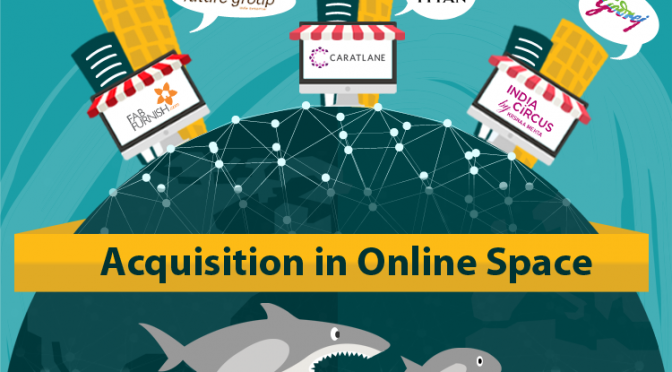
Lately, we have seen the offline players dive into the lucrative online market, by way of acquisitions, some of which include: FabFurnish by Future Group, CaratLane by Titan, India Circus by Godrej Group!

Let’s give you more detailed insights…

Future Group acquires FabFurnish…

Future Group acquired Rocket Internet’s online furniture platform – FabFurnish (Alix Retail Pvt. Ltd) for approximately ₹20 crores in April 2016.

This is a huge step by the Future Group, given that it is their first online acquisition. It is going to be merged with their home and furnishing business – HomeTown, which is now being expected to become a ₹800 to 1000 crores business by the end of this fiscal year.

This acquisition is being said to create waves in the sector and the online industry as a whole, and would also open the gates to many more such offline-online acquisitions in the future.

Founded in 2012 by Vikram Chopra, Mehul Agrawal, Vaibhav Aggarwal; FabFurnish is an online shopping portal for furniture and home ware with a diverse range of products. They are backed (with $30 Mn) by Rocket Internet, which is an eCommerce-focused Venture Capital firm and start-up incubator, and is well known for creating clones of successful Internet businesses and then selling them once the business gains scale.

Ashish Garg will remain the CEO of FabFurnish, and the management team along with their 100 (approx) employees are likely to join the Future Group as well.

Why did this deal take place?

The primary reason for Future Group to acquire FabFurnish, as per media reports, is to help grow the online presence along with the delivery model of their brand HomeTown, and also to grow their presence in markets where they do not have offline stores or have minimal reach, as well.

In addition to that, this move will also help the Future Group to build a wall ahead of retail giant IKEA who intends to enter India in 2017, and will take at least two to three years to become a ₹1,000 crore company.

On the other end – Rocket Internet, who had entered in the Indian market by incubating half a dozen companies including––Jabong, Foodpanda, Fabfurnish, OfficeYes, HomesandHeaven and Couponnation; found itself to be in a fix, when to their surprise, none of these companies had managed to become big enough to offer an exit.

FabFurnish will be the German group’s first exit.

Rocket Internet had been trying to exit its India businesses for a while, and had been desperately and aggressively looking for buyers. However, to their luck; most of their deals never managed to see daylight!

More specifically – FabFurnish, was bleeding like never before, had fired almost one-fourth of their workforce, and was now making monthly revenues of ₹1 crores (which used to be ₹3.5 crores, two years back).

Hence, despite being an early entrant; when FabFurnish was not able to sustain its position, Rocket Internet decided to put it on sale.

Titan acquires CaratLane…

Watches and jewellery maker and a part of the $108 Bn conglomerate Tata Group, Titan Company has acquired a majority stake in the Chennai-based online jewellery portal – CaratLane. They would be acquiring the stake from Carat Lane’s long time investor, Tiger Global, in an all cash deal. There will be no dilution by the promoters.

The acquisition would be completed after the company completes their due diligence, which should be completed by June, post which the exact stake of the deal shall be revealed. But media reports suggest that, Titan’s stake would be more than 51% in the company.

Founded by Mithun Sancheti and Incorporated in 2007 – CaratLane follows an Omni Channel strategy wherein it not only sells online, but also at 13 offline stores across the country in Bangalore, Delhi/NCR, Hyderabad, Coimbatore, Chandigarh, Chennai, Thane and Pune. The company had raised a total of nearly ₹350 crore in funding.

Interestingly, CaratLane currently competes with players like BlueStone, who have raised funding from Tata Group’s Chairman Emeritus Ratan Tata.

Post the announcement of the deal – Shares of Titan Company rose up by 1.74% and closed at 365.45, on NSE.

Why did Titan acquire the stake in CaratLane?

To begin with – Titan could have easily launched their own platform, but this acquisition made more sense to them, since there are synergies between their operations.

Tanishq the jewellery arm of titan; even after accounting for about 80% of their business, still has its limitations, and is restricted by its boundaries. Whereas, CaratLane is able to reach out to more customers, given that it is a leader in the online jewellery market in India across the value chain (design, manufacturing and marketing).

But even after that and even after having revenues of ₹250 crore with good gross margins, CaratLane is said to be making losses, given their heavy spending on advertising. Basically, Offline Brand Value and Funding is one of their biggest limitations!

So, when both come together – while Titan will get a stronghold in the online space, CaratLane will get the backing of Tanishq, a big brand in the jewellery industry.

For CaratLane – the collaboration is sure to get them a lot of credibility, along with access to Titan’s strong backend capabilities.

While for Titan, the acquisition would get them significant capabilities in the eCommerce space along with overall digital capabilities that are far superior than the rest in the space.

Godrej Group acquires India Circus…

The 10,000 crores Godrej and Boyce Manufacturing Company Limited, the holding company of the Godrej Group has acquired a 51% stake for an undisclosed amount, in India Circus Retail Private Limited that runs an online home decor and accessories portal Indiacircus.com. This acquisition was lead by Navroze Godrej, Head of Strategy and Innovation at Godrej & Boyce.

It is an online-led retail venture of designer Krsnaa Mehta, and will close the Fiscal Year 2016 with revenue of ₹20 crores.

As per media reports, they have acquired the stake in India Circus, because they also run a company that provides similar offerings that includes contemporary and affordable home decor and personal accessories, similar to that of India Circus.

Going Ahead – Krsnaa Mehta, Executive Director of India Circus will be focusing on the Design, while Godrej & Boyce will take care of the Operations and Marketing of this end of the venture. All 35 India Circus employees have been retained. India Circus will continue to retain its identity and brand name, but under Godrej.

Since Godrej Group holds further interests in furniture, consumer durables and packaged consumer goods sector, they would be continuing to expand their portfolio in the segment by investing in existing brands and also creating their own as well. Furthermore, they would also be looking at acquisitions and collaborations in the areas of security, energy and renewable in India and abroad, too.

Why did Godrej Group acquire the stake in India Circus?

The primary reason was to strengthen their lifestyle footprint and also complement their existing lifestyle brands like Godrej Interio.

Additionally, Godrej is also seen to be aggressively expanding its footprint in all the sectors it holds business in, either by acquiring ventures or by starting one of its own!

Their target is to increase their revenues by 10-fold in the next 10 years, and would mostly be doing so by acquisitions and collaborations, and has set the ball rolling, by acquiring a major stake in India Circus.

And since they are in the process of launching their own website that would be showcasing their entire range of products available across the different group companies, shortly; this investment in India Circus would only help add value to their offerings, strengthening it furthermore!

Hence, going ahead –– since they saw a complementing synergy in the philosophy, functioning and offering of India Circus and Godrej Interio; Godrej aims to strengthen India Circus’s market position as a lifestyle brand even more, by adding their own brand value to it.

They would be including all of India Circus’s products at all the 50 company owned stores and 200 franchise stores of Godrej, and plan to grown their market revenue by 500% over the next two years, as well. In turn, this would automatically strengthen and increase their online presence, and on the other end, India Circus would get the much needed offline channel of sales.

Is it time for offline players to start acquiring the mature Online Businesses?

It is a given that the online shoppers and the internet market is going to grow dramatically in the next few years. The earlier you get on this boat, the better!

Since brick & mortar retailers will require a considerable amount of time and investment to build their eCommerce business, acquisition of online companies is the best solution, and many online start-ups are more than happy to get acquired by reputed offline companies too!

We have already seen the transition begin as well. Leading legacy retail brands have begun to recognize the potential of the online market and are looking at ways and means to go online. They are increasingly looking at associations with existing online players or acquiring them as well.

Some of the other recent acquisitions include: Ek Stop by Godrej Nature’s Basket, Freecultr by Textile firm Arvind, etc…

As a matter of fact – Indian offline companies are not the only ones who are interested in the online start-ups, and many international firms are eyeing the Indian online market too!

Recently, it was announced that Chinese handset maker Xiaomi, who has made a total of 55 investments, was looking to acquire several start-ups in India. The focus in India will remain on software and Internet companies.

store

FMCG Brands: eCommerce is calling you, it’s high time you answered…!

India’s eCommerce has transitioned from $3.9 billion in 2009, $12.6 Billion in 2013 to $24 Billion in 2015, and is expected to touch $100 Billion by 2020 as well. According to Google India, the Q1 of 2014 saw 35 Million online shoppers in India, which is further expected to cross the 100 Million mark by the end of 2016, as well.

Some of the Key drivers that are leading to this phenomenal growth of the Indian eCommerce include: –

  • With just 34% of the population using the internet, we are the 2nd largest internet userbase in the world, which is rising at an alarming rate.
  • Rapidly increasing 3G internet users, and a recent introduction of 4G across the country.
  • Explosive growth of Smartphone users
  • Rising standards of living
  • Unlike Offline Retailers, internet offers a much wider product range at highly competitive prices
  • eCommerce also greatly reduces the inventory and real estate costs

But these are just the stats about the eCommerce market. Let’s give you more detailed reasons why it is high time an FMCG brand joined the eCommerce bandwagon!

Let’s begin with an overall market summary…

FMCG, also known as the Fast Moving Consumer Goods are the essential items we use in our daily lives, such as: Personal care items, food, Paper products, Pharmaceuticals, Consumer Electronics, Plastic goods, Printing and Stationery, Alcoholic Drinks, Tobacco and Cigarettes, etc…

During the initial days, FMCG players were not really keen on launching their own portals to sell the products on the internet and preferred to choose the safer route and collaborated with the eCommerce websites such as Snapdeal, Flipkart and Amazon India, to keep up with the new-age retailing and sell on the internet.

But over the period of time, and with the changing times; the bigger players saw the potential of the eCommerce market and decided to jump on the bandwagon. The huge potential of online shopping caught the attention of top FMCG companies such as Dabur, Marico, Bisleri and ITC, which started pushing their products on the internet.

Godrej not only tied up with generalised eCommerce marketplaces like Snapdeal, but also began preparations to launch their own individual portals as well. Additionally, they are in preparations to acquire an E-Grocery site, and are also anticipating 5-8% of FMCG sales coming from online channels.

On the other hand, Dabur India is not only running four portals of their own, but is also working with multiple partners like Amazon India and Flipkart across the categories to sell our products online.

UL (Unilever India) has already switched its direct selling model to an online ordering platform, while Marico India is selling their products through Flipkart and Amazon, and is also building its own eCommerce capabilities though its company’s website as well.

And, ITC already sells their food products their own website shopping.kitchensofindia.com, and also has listed its products on various other eCommerce marketplaces, too.

But what came as a surprise and shock to most of the FMCG players and the consumers, is the entry of the recently risen Patanjali, which had transformed into a ₹5000 crores entity in such a short time. They have also set foot in the eCommerce arena by way of tie-ups with marketplaces, along with their own eCommerce portal, giving other players a nightmare.

Why must offline FMCG and Consumer Durable Brands come online?

Aside from the obvious factors that we mentioned above – India has seen a phenomenal rise in the jump in the number of internet users, which is seen to be growing at an unprecedented rate, and is adding around 6 Million new entrants every month.

eCommerce is seen to be growing much faster than what anyone had expected. Instead of following the historical pattern of evolution from traditional trade to modern retail, to eCommerce, and then to mCommerce (Mobile Commerce); Indian market has leapfrogged from traditional trade to mCommerce, directly.

According to a research conducted by TMW and Marketing Sciences amongst 2,000 people across different age groups; the young consumers in India are the most ‘rational’ ones and more likely to spend more time, thus increasing the potential of purchases. To add to that, shoppers aged between the age of 18 and 24 are 174 % more likely to use recommendations on the Social Media than shoppers aged beyond the age of 25.

Customers are attracted to online shopping not only because of high levels of convenience, but also because of broader options, competitive pricing, and better access to information. And business organizations use the online medium to sell not only because the costs are lower comparatively, but also because it offers access to a global market, increases customer value, and builds sustainable capabilities.

eCommerce gives you the leverage to establish a market presence, or to boost your current market position by offering a cheaper and more competent distribution chain, to a much wider audience.

A recent joint report called “Re-Imagining FMCG in India”, submitted by CII and Boston Consulting Group (BCG), noted that –– growth in disposable income, increased urbanisation, and the increase in the number of nuclear households would be the key reasons for the growth of the Indian branded FMCG sector.

Some more key pointers of that report included: –

The tier 2-4 towns and rural regions would play a larger role in the forming of this growth, as their contribution will be an important source of demand for the sector. In the near future – the smaller towns and cities across India are expected to contribute the most, in shaping the future demand for the FMCG sector, while eCommerce companies will account for a much larger share of the sales of these companies.

Households with more than Rs.10 lakh annual income would account for 50% of the spending in the category, causing the “Premiumization” across categories; thus, transitioning them from unbranded to branded.

The decisions of more that 150 Million consumers would be digitally influenced in the FMCG sector by 2020, who’s spending would then increase to more than $45 billion (₹298,323 crores) on FMCG categories.

And although some of large eCommerce companies in India including Flipkart, Snapdeal, Amazon India, etc., have managed to gain the first-mover advantage, but that shouldn’t mean that others have lost the opportunity.

In fact, these companies have helped the others in educating the consumer of such services, and since, the large offline FMCG players have their brand value and loyal consumer base, they can easily sweep in to the market now.

Believe it or not – the future actually belongs to those retailers and brands that hold the potential to see the larger picture and who are able to successfully use online and offline, to their benefits by developing a defined multi-channel strategy.

What you need to know, before you go online?

Online is quicker and more convenient, it gives shoppers more control over their budgets and means there is a much wider range of products available. While fun might seem like an exception, with the other motivations seeming to focus on meeting more practical needs, there is more potential to meet this need using the online channel than in physical stores.

By profiling shoppers further to develop a better understanding of these motivations – as well as the pressures, aspirations and functional needs that lie behind them – retailers and brands have the potential to improve their online offer, capture new customers and ultimately grow their revenue

The eCommerce channel clearly presents significant growth opportunities for retailers and brands, but how can these be exploited, completely depends on the execution!

For instance – the profile of early online adopters i.e. young, wealthy, urban/suburban families with children, is consistent across all countries; however, what motivates shoppers to go online differs depending on the local environment and other socio-economic factors.

Generically speaking, there are four types of shopper motivations that drives FMCG consumers: Cost, Time, Availability and Fun. These can easily be attained by using some intelligent Digital and Direct to Consumer Marketing Strategies.

And understanding these motivations is the trick to driving sales!

Other than that, simple and ready-to-use eCommerce portals help you to start your own online shop with ease. They are usually installed on the company’s web-server and the existing supply chain can easily be integrated so that ordering, payment, delivery, accounting and warehousing can be automated to a large extent as well.

One of the best ones currently available in the market includes YoKart that not only helps you to launch your own products, but also offers you the option to have a Multivendor Marketplace as well!

Some of its features includes a Responsive Design Layout for all eCommerce websites, State-of-the-art Security system, Scalable Scripts, Handcrafted Structure, Economical and Competitive Packages, Admin Dashboards for both you and your Suppliers, Settings Control Panel, etc…

stickk.com

StickK: Helping you fulfil your resolutions / goals / commitments!

What is stickK?

Founded in 2007 – stickK.com, which is based on the principles of behavioural economics, is in simple terms, a free goal-setting platform!

Basically, the idea basically is to set a goal / resolution that you are finding difficult to achieve, and then choose the appropriate reward for success or punishment for failure!

In other words – putting your money where your mouth is!

Using their goal-setting framework to create Commitment Contracts, one can successfully achieve their resolutions and goals. Be it – leaving smoking / drinking, reducing / gaining weight, reaching on time, or for that matter any other goal; stickK can help you achieve it!

The difference between other goal-setting platforms and stickK is that, stickK functions on a methodology that is specifically structured to help people by leveraging the power of incentives and accountability in changing their behaviour.

And, stickK also allows users to create a custom plan-of-action of how to turn their goal into a reality.

Additionally, stickK also offers Companies the opportunity to encourage their employees to achieve health and/or work related Commitments, such as: losing weight, quitting smoking, exercising regularly, or meeting sales quotas, etc…with the help of unique methods!

Other than these – stickK also works with Schools, Gyms, Doctors / Dentists, Governments and Municipalities, Banks and Financial Advisors, etc…to help and motivate their individual users to achieve the required targets or goals!

TRIVIA: The Company’s name comes from ‘sticking to it, and the second ‘K’ is the legal shorthand for a contract.  It also refers to carrot and stick.

How does stickK work?

stickK works in ways where it provides you with the necessary tools to fight back against human nature.

You start by defining your Goal explicitly! stickK has One-Shot Commitments (that are chosen for goals that must be completed by the ending date of the Commitment Contract) and Ongoing Commitments (that are chosen for goals that are completed in stages and each stage is measured independently in the form of weekly reports)

After you define the goal, you have to choose a Timeline to accomplish the given goal, post which, you need to put something up for Stake! As part of your Commitment Contract, people are encouraged to put money on stake, to help them motivate further in achieving their goal.

Next, you need to assign a Referee! This is ideally a trusted friend or a family member, who would be verifying and monitoring the progress report. When a user submits a report to the website, the referee is asked to confirm the accuracy of the report.

Lastly, you can also invite your friends to follow your Commitment and progress, and cheer you along as Supporters. They would receive weekly updates about your progress.

And what if the contract is broken?

Well, there you face the punishment you have chosen. Yes, you literally face that punishment!

So for instance, if you have opted to give away money, then your money will be transferred to the chosen parties / organizations / charities.

To up the ante, you can also pick a specific organization whose views you oppose (within reason and legitimacy, of course!) for the money to be transferred to. Also referred to as “anti-charities” at stickK! StickK has a list of 23 anti-charities to choose from. These are organizations on either side of several highly controversial issues.

The purpose of an anti-charity is to provide an added motivation for you to achieve your goal, and since, it is something you dislike, you will work even harder to ensure that the money doesn’t fall into wrong hands.

And to top it all – all of that is mentioned on a “Commitment Contract” which is a legally binding agreement of the aforementioned. So you can’t escape it too!

Why does the idea of stickK work?

The reason this idea works, is simply because, it plays with the mind of the user!

The trick here is that, Behavioural Science has discovered that there are two most effective factors that help people in achieving their targets: Incentives and Accountability!

Financial Incentives and Accountability, often gets people to do stuff.

So instead of prohibiting the behaviour, it allows the users to continue their behaviour if they want to—but also sets up consequences for the same.

Behavioural Science tells us that humans are loss-averse, and are social animals that make decisions in a time-inconsistent manner, which means that, we don’t like losing things and most often give in to immediate / present satisfaction,  (e.g. smoking) at the expense of our long term goals (e.g. health).

Studies on behavioural economics have proved that, people who put their money (or something else) on stake, are most like to achieve a goal, also because a legal contract is involved!

And it makes sense too!

Think of it, we all begin with a task / goal with hopes to go all the way achieving the same, but most of the time and most of us, don’t even reach half way. This is because we lack motivation and fear!

A Commitment Contract, gives us the needed motivation and fear, and makes backing out a whole lot harder.

That’s why stickK works so well—stickK offers the most appropriate incentives and accountability; thus, increasing the e chances at success by up to three-folds.

Who are the founders?

stickK was founded by Dean Karlan and Ian Ayres in 2007!

It is currently lead by CEO – Jordan Goldberg. He has completed his studies from the Yale University, and also holds a Management degree from the Yale University – Yale School of Management, as well. Soon after he completed his studies in 2006, he was picked up by his professors Dean and Ian to take charge as the CEO of stickK!

Talk about the founders…

  • Dean Karlan

Dean has completed his Ph.D. in Economics from the Massachusetts Institute of Technology, Masters in Business Administration and an M.P.P. from the University of Chicago, and also holds a Bachelors of Arts in International Affairs degree from the University of Virginia.

Karlan attended the Duke University Talent Identification Program from 1982–1985.[4]

He had begun his career as an Investment Banking Analyst for the Bank of America (then Nationsbank) in September 1990.

After working with them for about 2 years, he then moved on to work with FINCA International as a Systems Consultant in September 1992.

This stint continued for around 2.5 years, post which he joined the prestigious Princeton University July 2002 as an Assistant Professor and went on to work with them for about 3 years.

Finally in 2005, Dean moved on to work with Yale University as the Professor of Economics, and today, even after 11 years, he still continues to work with them as well.

While at it, in 2007, Dean along with Ian founded stickK.com!

Over the period of time, he has also got associated with various institutions such as: President at the Innovations for Poverty Action, Member of Grameen Foundation Technology Center Advisory Board, Non-Resident Fellow at the Center for Global Development, and many more…

  • Ian Ayres

Ian is an American lawyer, Economist, and is a professor at the Yale Law School and at the Yale School of Management.

Ian had graduated from the Yale University with a dual degree in Russian studies and Economics in 1981, post which he also went on to achieve his J.D. at Yale Law School in 1986. Ian also holds a Ph.D. in Economics from the Massachusetts Institute of Technology in 1988.

Over the period of time, Ian has managed to attain a position as one of the 250 most prolific and most-referred legal scholars of his generation, and has also managed to publish more than 8 books and over 100 articles in law reviews and magazines on a variety of subjects.

Talking about his career, Ian has taught at some of the most prestigious Universities in the world, some of which include: Yale University, Stanford Law School, the Moscow State Institute of International Relations Cardoza Law Institute, Northwestern University School of Law, the University of Iowa College of Law, the University of Virginia School of Law, the University of Illinois College of Law, the University of Toronto Law School, etc…

Since 1994, Ayres has served as a professor at the Yale Law School and the Yale School of Management, where he teaches commercial law, corporations, corporate finance, civil rights, antitrust, contracts, law and economics, property, quantitative methods, etc…

And finally in 2007, Ian along with Dena also cofounded StickK.

What’s their story?

In 2002, two tubby graduate economics students Dean Karlan & John Romalis, from the Massachusetts Institute of Technology wanted to lose some weight and managed to achieve the targets, by putting a wager.

So the stakes were – Dean would pay $10,000 to John Romalis if he wasn’t able to lose 17kgs by an agreed date, and vice versa. And if both failed then, the one who failed by least would get $5,000 from the other.

The deal sounded fair to both, and they happily shelled out the money. Later, this initial deal was replaced by a “Maintenance Contract” wherein, either of them could show up unannounced to check the weight of the other and collect $5,000 for each pound over an agreed weight.

Who won? Not Important!

What’s important was that, that day Dean learned something that helped him greatly in the future!

Dean learnt two very important principles of Behavioural Economics from their personal experience – loss aversion and time inconsistency. It made him understand the Behavioural Economics of combining insights from psychology and economics to explain how people make decisions.

This is the logic that gave them the idea of stickK.com, post which, in 2007, Dean along with Ian founded stickK.com in New Haven!

Initially, they had invested their own capital of $150,000 into the company. They also recruited Jordan Goldberg (then a student at the Yale School of Management), to run the company as the CEO, and subsequently, also moved the company to New York City as well. The web site was launched in the beginning of 2008.

According to Jordan, there was a high chance of users who put money on the line to achieve their goals, as compared to the rest of the 35% who didn’t put any money.

In May 2010, stickK.com also launched Choose You, where individuals could write commitment contracts and have their friends or family pledge money to the American Cancer Society if the contract is fulfilled. This was done on a charitable note to help those in need!

In the same year, stickK also launched their first-ever private label version of their public platform, for the organizations and corporations to encourage behaviour change with their employees.

Large employers used stickK for employee wellness programs, Hospitals and healthcare providers offered stickK to the patients, and Businesses provided stickK programs to their consumers to increase brand awareness.

stickK, as a brand has also been written about and quoted several times in many articles and books such as: by Steven Levitt, appearance in the book “More Than Good Intentions”, etc…

Lastly, over the period of time, the company has raised a total of $2.23 Million in 3 Rounds from undisclosed investors. So far, they also have $25,119,475 Staked on the line by users, 308,280 Commitments created, 795,725 Workouts completed and 15,043,382 cigarettes not smoked.

housetrip business model analysis

HouseTrip.com: one of the largest holiday rental marketplace in the world

What is HouseTrip?

Founded in 2009 and headquartered in UK (London), Portugal (Lisbon) and Switzerland (Lausanne); HouseTrip is one of the largest holiday rental marketplace in the world for people to book and list holiday rentals.

It is a portal that allows homeowners and holiday rental managers (known as ‘hosts’) to list and rent out their properties to guests who wish to use it during their trip. One can use this marketplace to securely book a holiday rental for a vacation in Europe, Asia, Africa, North America, South America and Australia.

The listings on the site are divided into different categories such as a flat, apartment or house, and one can also choose alternative property types such as a boat or castle too. Either ways, no private bedrooms are listed or can be booked, and only entire properties can be booked using HouseTrip.

Hosts can list their properties for limited periods of time as well, which gives the travellers the opportunity to be in a real home for their short-term stays.

For the Hosts

Listing a property on HouseTrip is completely free of charge and in order to create a property listing, the host has to complete an online profile. They have to fill in all the details about their available rental, along with three photos which must include a photo of each room in the property, and must also have accompany all listings before they go live.

The price can be determined by the host, and they can also charge different prices based on per night or weekly rates by using HouseTrip’s calendar tools as well. Additionally, they can also add in detailed guest restrictions in the property description (for example ‘no large groups’, ‘no smoking’, etc) and outline security deposits.

Once all details are completed, these listings are then passed on to the verification department at their Lisbon office before the listing goes live. This team verifies everything from photo quality, descriptions, etc to performing thorough fraud detection checks and getting in touch with the host party in cases where information is lacking. They also have a “Fraudbuster” team whose job is to track anything suspicious that occurs on the site as well.

One can manage the requests and bookings using the free and easy-to-use tools, including a dedicated mobile app offered by HouseTrip. They also have a multi-lingual service team of more than 100 people to assist you.

All the payments are handled using a secure payment system. HouseTrip adds their service fee of 10% – 20%, to the amount that is specified by the hosts, while collecting the money.

Although HouseTrip collects the money during the booking stages, but they transfer it to the host, two days after the guests have checked-in, to ensure that the properties match guest’s expectations.

Guests are also encouraged to review the properties they use, after the completion of their stay.

For the Guests

To book a property, all you need to do is: –

  • Visit housetrip.com
  • Enter the location, check-in & check-out dates and number of people staying, to search for the available properties
  • Browse through the available options
    • While at it, you are provided with an overview of the property that includes: a detailed description, what all does the property includes, add-ons, images of all the rooms, along with map of the location and reviews by other guests
  • If you like the property, you need to send an enquiry, for which you shall get a reply within 24 hours, post which, you can book online securely, for which you will also receive a confirmation within 36 hours
  • After a booking is made HouseTrip also double-checks with the host if the property is still available
  • It is advised and encouraged that you send multiple enquiries just to be on the safe side.

Who are the founders?

HouseTrip was founded by the husband-wife duo Arnaud Bertrand and Junjun Chen in 2009, but George Hadjigeorgiou currently runs the company as its CEO.

Arnaud Bertrand & Junjun Chen

Arnaud grew up in France till the age of 18, post which, he moved to the Ecole Hoteliere de Lausanne in Switzerland for further studies.

Junjun, too moved to Ecole Hoteliere de Lausanne in Switzerland for further studies around the same time as well.

They completed their Bachelors in Hospitality and Entrepreneurship in 2009 from Ecole hôtelière de Lausanne, before which they had also taken a Summer School Course in International Corporate Governance in 2008 from the prestigious Harvard University.

While they were studying, they had also worked as interns as well. Arnaud had worked with PKF Consulting as an Intern and Junior Hospitality Consultant for about 8 months. Junjun had worked with STR Global handling their Customer service & relationship, clients training and data research for about 6 months.

And since both their parents were entrepreneurs, they just could not picture themselves being anything else other than their own bosses, and hence, post their university, they started HouseTrip.

Arnaud was the CEO of the company and Junjun was the CFO. Since then, Arnaud has also invested in several companies including: UpMySport, TutorFair and Deliveroo. More recently, in 2014, he stepped down from the position of the CEO and passed on the baton to George Hadjigeorgiou.

George Hadjigeorgiou

George is the CEO of HouseTrip since the last two years.

He has completed his Bachelors in Mechanical Engineering and Economics from the Tufts University, and Masters in Mechanical Engineering from the Massachusetts Institute of Technology.

He started his career after completing his masters in 1998 with Accenture as a Manager, Strategy Practice and went on to work with them for about 2 years. He then rejoined them in 2002 as a Senior Manager, Strategy Practice and worked for about two and half years.

During this period, he cofounded his first venture Quaris.com (part of Accenture Technology Ventures) in 1999, and also worked with Eurimac as a Business Development Director in 2000 as well.

In 2004, George joined Yahoo into Corporate Development and worked with them for about 5 years, during which he also got promoted to a General Manager for Yahoo (EU Communication/Community Products & Social Media), as well.

Between 2009 and 2011, he worked with XE and GoldenGroup (GoldenDeals, GoldenBrands, GoldenTraveller), as their COO / Board Member and CEO / Founder, respectively.

And then finally in 2012, he joined HouseTrip.com as their CBO, and eventually moved up the ranks to become the COO, and more recently the CEO of the company!

How has their growth been so far?

To begin with – the idea of HouseTrip had first sparked in Easter 2007!

The husband-wife were completing their internships at L’Ecole Hoteliere de Lausanne in London and decided to take a break from their routine.

The couple decided that they needed a holiday, but did not want to stay in a hotel. But the booking methods for holiday rentals were much more difficult and complex than they imagined it to be.

They tried to book a B&B in Scotland and the process for finding and renting a B&B (Bed & Breakfast) was so complicated, that they literally had to spend 2 weeks calling potential hosts before finally having one booked.

Additionally, they also found it very difficult to rent out their place in Lausanne, for the period they were away for the trip. They eventually had to give in, and leave the place empty.

This was probably because the concept wasn’t that familiar amongst the masses, and there wasn’t any centralized medium offering such services.

Having studied hospitality management, the two were well versed in how easy it was to book a hotel room online, which is what made them think – why not for the holiday rental market too?

And since, Arnaud had got the experience of both the sides of the spectrum: the host and the guest, they got the idea of HouseTrip.

Other than the base idea itself, what differentiated them from the rest was the level of protection they offered to travellers. When booking through HouseTrip, travellers are automatically protected by the guarantees and cancellation policies for free. Additionally, any property on HouseTrip is directly bookable and travellers pay securely through the website itself.

And, after deep brainstorming, 1,000-odd Swiss francs from their personal pockets, no idea on how to build a website, the husband-wife duo started the journey of HouseTrip.

The first step was to fund their first job hire which is building a website, for which they journeyed across Switzerland and Europe pitching to over 200 business angels in the hope that a view would see potential in their idea.

After a lot of rejections they finally found three [angels] who invested 50,000 Swiss francs each. Thus giving life to their project!

This is how HouseTrip was founded in 2009, and launched in January 2010!

They had started off with their home as their office, and about 200 properties around Paris, Berlin and London.

As much as motivating it was, given that they were convinced that the idea would succeed, the initial phase was the hardest. Free weekends were out of question.

And they proved the same when they managed to get bookings of more than 20,000 people in the first year of their operation itself. That year, they generated 2.5 million gross bookings in Swiss Francs.

By 2011, HouseTrip had moved into their administrative, finance, development and marketing teams to London with a second office established in Lisbon for customer service queries as well. By now they were experiencing a growth of more than 1000%, both in terms of listing numbers and guest bookings.

In 2012, they celebrated their 500,000th night booked through HouseTrip since their launch, and by 2014, their property listings on HouseTrip.com had increased to more than 330,000, making them one of the largest providers of holiday rentals world.

In the same year of 2014, Arnaud Bertrand also stepped down as the CEO of the company, and passed on the baton to the then COO – George Hadjigeorgiou. Arnaud moved on to the role of the President of the company. They now have more than 200 employees working across Europe.

The company has raised a total of more than $59.7 Mn from 3 Investors including – Accel, Balderton Capital and Index Ventures.

More recently, in the current month of April 2016 – HouseTrip got acquired by TripAdvisor for an undisclosed amount.

Although TripAdvisor’s core business is being a travel website for user-generated reviews, their natural extension of this was to expand to provide mechanisms to book accommodations. And, no prizes for guessing that, acquisitions are generally the best way to expand to such kind of growth.

To do so, TripAdvisor has made a series of acquisitions, similar to HouseTrip, which includes: HolidayLettings and Niumba.com.

Anyway! Moving ahead, HouseTrip’s inventory of properties will be infused into TripAdvisor Vacation Rentals, and HouseTrip brand will also continue as part of TripAdvisor.