
ClearTax

ClearTax: Tax Return e-filing – Simplified!

What is ClearTax?

Manufactured by ClearSharp Technology Private Limited and headquartered in Bangalore – ClearTax is an Indian Income Tax Return e-filing website.

Unlike the government-owned Income Tax department’s excel/Java based software, ClearTax simplifies the process by offering the utmost simplicity and accuracy, and at the same time getting rid of the notion that taxes are complex; ClearTax has been designed to prepare and file their Income Tax Returns in about 10 mins.

Some of their offerings include: Indian Taxation, Income Tax Returns, Electronic filing of Income Tax Returns, Chartered Accountant Tax Software, TDS, Compliance, Tax Deduction at Source, etc….

Their website is especially designed for the Indian taxpayers that do or do not have the tax knowledge. Taxpayers can visit the website, upload their Form-16, automatically get the tax return filings prepared by the ClearTax software, and file their income tax returns by uploading Form 16 or by preparing the income tax returns on the website.

Other than Form 16, ClearTax also helps Indian taxpayers prepare for other income tax return forms like ITR-2A, ITR-2, ITR-3, ITR-4S, ITR-4, ITR-5 and ITR-6. A taxpayer can provide tax information like income from capital gains, other sources of income, income from house property, income from business or profession apart from income from salary, to prepare the tax returns.

Apart from that, ClearTax also offers this service to businesses; freelancers and small businesses, for now. ClearTax’s accountants help them claim expenses, which in turn can increase the amount of their tax return, by asking them questions over a phone call.

Along with that, the website also offers various tax tools for the laymen, including: –

  • Income tax calculator
  • Income tax check refund status tool
  • House rent allowance (HRA) calculator
  • Residential status calculator

Additionally, to help the users further, they also have different kinds of Guides & How-tos, as well.

Other than ClearTax, the company also offers two other products in the ‘taxes’ domain: –

  1. ClearTDS (cleartds.com) – Used to prepare TDS filing without installing any software.
  2. TaxCloud (taxcloudindia.com) – A web based IT Return and e-TDS Software mainly used by the CAs, Accountants and Companies.

Although, these services are completely free of cost, but if you require special or expert assistance, then there are paid CA plans, under which, ClearTax would connect you with many reputed CA firms across the country who are experienced and up-to-date with the latest Tax Codes.

Market Segmentation, strategies and partnerships…!

  • Beginning with Market Segmentation…

As a whole, ClearTax is targeting the youth from the metro cities across India that ideally fall in the age group of 25 to 34 years, and are mostly from the IT and BFSI sectors. Additionally, they are also targeting freelancers and small businesses as well. these mostly include freelancers like programmers, designers, photographers, journalists, etc…

But according to their stats, one of the biggest growing markets for ClearTax are the Indian citizens that are currently living in other countries. ClearTax has a service that is specifically designed keeping their needs in mind and costs about $40.

Now, even though ClearTax is a B2C (Business to Customer) business model, but they use a B2B model strategy to find their users. They do so, by reaching out to large corporations, which in turn offer ClearTax for free or at a discount to their employees. Some of such corportations include: Royal Bank of Scotland, InMobi, Flipkart, etc…

  • Moving on to their strategies…

Their business model as a whole is grand strategy of the company.

What we mean is that, even till date, most of the people face huge issues in paying taxes. They have no clue about the whole process. And talking to the IT department is altogether a different complex matter.

The government’s e-filing software is also observed to be very complex and with a lot of tax jargons, and since people need to understand which out of seven tax forms they need to fill; the whole process can be pretty overwhelming for the ones who are unfamiliar with income taxes.

Basically, complexity is the biggest problem of this space!

So by making the process of filing taxes free, easier, faster, with less steps and potential headaches, ClearTax has managed to simplify the whole process for the masses, to a very large extent. At ClearTax, you don’t have to download IT department’s file, no Microsoft Excel or Java required, all calculations done online, and many more like these.

Apart from the ones mentioned above, there are a number of clever things that ClearTax does to simplify the process, like: –

  1. ClearTax does not ask the user to select the applicable ITR form, instead, it makes this selection for the users based on the information they provide
  2. The process is nicely explained with menus and sub-menus.
  3. Since ITR forms are known to be very complicating given the sections and fields that need to be completed, ClearTax simplifies the whole thing by giving small pieces of relevant information to avoid the confusion.
  4. ClearTax automatically imports your TDS statements from IT department’s servers, if asked.
  5. If a tax payment is due, then it also generates a pre-filled challan as well.
  • Lastly, talking about their Partnerships…

ClearTax has recently partnered with the Government of Karnataka for their m-governance platform — Karnataka Mobile One to provide e-filing services to all Karnataka citizens. Institute of Chartered Accountants of India (ICAI) has also partnered with ClearTax and launched TaxCloudIndia as an initiative for capacity building of CA firms and small & medium practitioners.

More recently, ClearTax has announced their three year-partnership with Union Bank of India (UBI), under which, ClearTax will offer free e-filing services to UBI employees and customers, and other tax-related services at discounted prices.

Together, ClearTax and UBI will also be running joint marketing campaigns to promote this alliance, and UBI will be promoting the adoption of ClearTax services in roughly 2000 branches across India too.

Who are the founders?

ClearTax was started by Archit Gupta along with his father Raja Ram Gupta in 2011. Srivatsan Chari and Ankit Solanki joined them later.

Raja Ram is a Chartered Accountant and is a Partner at New Delhi-based Rawla & Co., a chartered accountancy firm.

Raja Ram now acts as the adviser to the company, while Srivatsan is the VP – Business Operations and Ankit is the CTO.

  • Archit Gupta

Archit has completed his Bachelors in Computer Science and Engineering from the Indian Institute of Guwahati, and had also pursued his Masters in Computer Science from the University of Wisconsin-Madison.

While pursuing his bachelors, he began his career as a Research Intern with CINI Conosorzio Interuniversitario Nazionale per l’Informatica in 2005 for about a year.

In 2006, he joined the University of Wisconsin-Madison as a Research Assistant for about 2 years. While he was at it, he also joined Microsoft Research as a Research Intern in May 2007 for about 4 months as well.

After completing his education, he then began working for Data Domain / EMC BRS division as an Engineer in August 2008 and went on to work with them for about less than 3 years.

And then finally, in 2011, he started his own venture – ClearTax!

How has their growth been so far?

ClearTax was started in 2011. It all started during his days at the Silicon Valley!

He used to work for Data Domain during that time, which later got acquired for a massive $2.1 billion by EMC. During this period he had worked very closely with the start-up world and was exposed to the Silicon Valley start-up culture as well.

He got to learn a lot about the functioning of Silicon Valley during this whole cycle and was able to witness some of the things which he wouldn’t be able to learn otherwise.

In fact, even though, he used to work on research related to networks and routers, but he always wanted to be an entrepreneur and had a desire to start his own venture someday in India, as well.

This dream turned into reality in 2010, when Archit was trying to file his returns in India while working in the US, but faced huge difficulty and was unable to file returns online because the IT department utility was in Microsoft Excel sheets which wasn’t compatible with Apple Macbook back then.

Frustrated! This got the father and son to chatting on the phone about e-filing in India, and curious to see what the income-tax department was up to, Archit even tried to open the website (www.incometaxindiaefiling. gov.in) on his MacBook, but faced many difficulties.

The Guptas noticed that the website was not at all user friendly, especially for the ones filing taxes online for the first time.

That is when both of them decided to solve this pain point for good and made a venture out of it. Archit coded the software, while his father helped him with all the possible accounting issues.

And this is how they founded the company in February 2011, which then launched their first version of the product on 19th July of that year.

This was just 11 days before the tax filing season ended in India, and they had very few days left to test the product before the tax-filing season ended.

The fact that – Government is in preparations to make tax returns electronic for the nation soon, worked well in their favour.

In 2014, ClearTax was accepted into the Y Combinator Summer Batch of 2014 (YCS14) as one of the 47 start-ups that year. They received a seed capital of $120000 (around ₹73 lakhs) from Y Combinator.

The interesting thing was that, it was the fourth Indian start-up ever to be ever funded by Y Combinator, and was the first one to be focused on the Indian market.

Now, since their initiation, ClearTax had been self-funded and worked on a tight budget all along its initial years of operation, but soon, after coming back from the Y Combinator program, ClearTax shifted their base from Delhi to Bangalore to attract the best talent of the country, and aggressively began expanding.

By Jan 2016, they had even launched their own ‘Rent Receipt Application’ to help people living in rented accommodations, to reap its benefits on taxes.

And when we look at them today, ClearTax has reached to a different scale today. They had processed over 300,000 individuals tax return e-filings in 2014-15, which further increased to roughly 1.5 million users filing their returns using the website in the assessment year 2015-16.

They are currently a team of 55 people working out of two offices – Delhi and Bangalore, and are in preparations to hire another 150 employees by May 2016 as well.

yokart

Mega Event #YoKart100startups Giving birth to 100 ecommerce startups for FREE

The dream to launch the next billion-dollar ecommerce marketplace is common among every other aspiring entrepreneur. As the global ecommerce industry, pegged at $1155 billion, is expected to rise 30% in the next couple of years, this dream is obvious. Every other person wants to eat a piece of this humongous pie. If we talked about ecommerce marketplace few years ago, very few technology evangelists took cognizance of it. However, nowadays every other eCommerce marketplace captures the attention of consumers as well as VCs.

One of the reasons why launching an ecommerce marketplace has become a walk in the park is ecommerce platforms like YoKart. Such platforms have been helping several startups make a name for themselves globally.

History behind Yo!Kart

YoKart has always been the go-to name for startups for launching a multivendor ecommerce marketplace. Its advanced features and turnkey implementation make it the top most choice when it comes to premium features at the economical price. It takes into account all the key features necessary for website owners, visitors, and merchants.

YoKart was conceptualized with an aim to simplify the process of launching an ecommerce marketplace. Moreover, running a full-fledged ecommerce marketplace cost a lot of money, which is not ideal for early stage startups without any angel funding. Although there were platforms like Magento and Woo commerce, which allowed users to start an estore, adding additional features necessary for making it a full-fledged marketplace, did put a big hole in the pocket of the entrepreneur. In addition, it proved to be a huge hassle for the entrepreneur.

The ideal solution to such an issue was an ecommerce platform with all the options backing right in so that the entrepreneurs do not have to worry about technological know-how. In addition to this, the economic package offered by YoKart makes it one of the best choices for startups. YoKart is a perfect example of an ecommerce platform; high on features and low on cost. The fact remains that YoKart is a seamless way to launch the next billion-dollar marketplace.

What is the USP of Yo!Kart?

As already stated, it is an ecommerce platform aimed at launching multivendor ecommerce marketplaces. However, the thing that makes this platform outshine the rest is that it is economical, feature driven and can be customized to target niche markets. For example, if you want to launch online furniture marketplace or a lifestyle marketplace, then YoKart offers ample customization for you to target your niche market.

YoKart100startups makes Yo!Kart, even more, Startup friendly

Recently, YoKart won product of the year award at TiECON, Chandigarh. In the spirit of celebrating the acknowledgement of YoKart as well as encouraging aspiring entrepreneurs, a rare eCommerce event #YoKart100Startups was announced during which 100 copies of YoKart worth $99900 would be provided to aspiring entrepreneurs at no cost. This once in a lifetime opportunity makes comes as a boon for entrepreneurs, and would surely help several aspirant to bring their ecommerce dream to reality.

Why is YoKart100startups event relevant?

Let us consider an entrepreneur “X” having a robust business plan for an ecommerce marketplace. However, merely having an idea will not result in a successful business venture. One needs a robust marketplace, technical knowledge of running it as well as funds. In most of the cases, the above-mentioned pre-requisites are not readily available, making it difficult for the entrepreneur to bring that idea into reality. This is where YoKart100startups comes into picture allowing such entrepreneur a chance to turn their ecommerce dream into an actual online marketplace.

yokart100startups yokart

What is the prize?

As already discussed, 100 aspiring entrepreneurs would get full/default version of an award winning ecommerce platform, YoKart. In addition to this, they would also get one year of free post-delivery support via Email or Project Management System for fixing bugs/errors. Frame documentation will also be provided so that the entrepreneur could learn to customize the system.

That not all; YoKart has even collaborated with Semrush, a competitive intelligence suite for online marketing, for this event. Because of this partnership, Semrush will be offering a one-year account to 10 winners worth $8400 at no cost. Additionally, Semrush would also be giving away one-month free access worth $70 to all the registrants.

Who are eligible for this event?

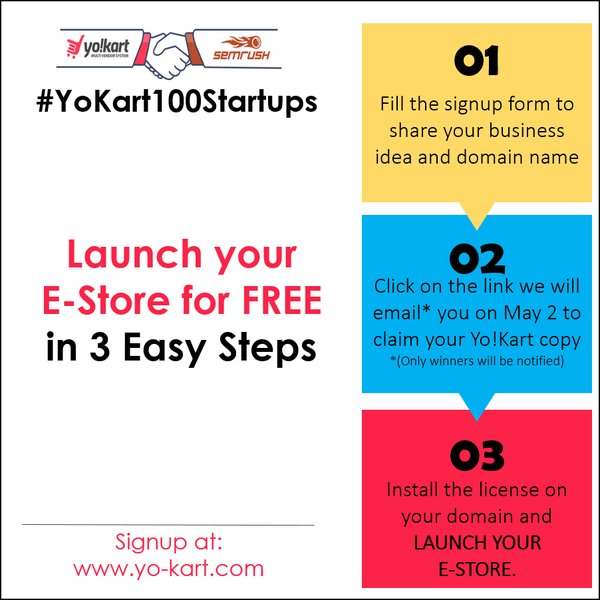
The best thing about this event is that it is neither a contest nor a challenge. This means that in order to become eligible for this event all you have to do is fill the signup form. In addition to this, you also require a business plan as well as registered domain. The registrations for the event are underway and would close soon. The results would then be declared, after which the winners would have 24 hours to claim their copy.

YoKart has been the go-to name for entrepreneurs looking to launch their own multivendor ecommerce marketplace. This event has just added a new feather to its mantle, offering entrepreneurs a robust ecommerce platform that does not cost a penny. If you are one of those aspiring entrepreneur looking to launch an ecommerce marketplace, then you must not miss this rare opportunity. Register before the window of opportunity closes.

EKART – LOGISTICS ARM OF FLIPKART

eKart : the lesser known Logistics Arm of Flipkart

Going by the current market trends – eCommerce as an industry has witnessed an unusual rise in business in the past some time. With PayTM joining Flipkart and Snapdeal in the eight-member unicorn club, eCommerce industry has clearly stolen the limelight!

And according to a recent report submitted by Bank of America Merrill Lynch in 2015 – the eCommerce market in India is expected to be worth $220 Bn by 2025 as well.

But since, the logistics market remains to be one of the most unorganized markets in India, speedy delivery still remains to be an unsolved pain-point and to worsen that, there isn’t any big player that can provide pan-India access at economical cost too.

Keeping that aspect in mind – going ahead, logistics would certainly be the factor to potentially define a company’s success. In fact, according to a report submitted by Market Researcher Novonous; India’s logistics industry which stands at $300 Bn billion is estimated to grow at a CAGR of 12.17% by 2020.

And one of the top contenders that holds the highest chance to rule the market remains – eKart!

Who is eKart?

To keep it short and simple – Owned and operated by Flipkart; eKart is their preferred logistics partner that helps them with almost all their deliveries to all major locations across India.

It had begun in 2010 as Flipkart Logistics and then was later changed to an independent entity in attempts to capture a larger market share. Most of their deliveries are taken care by eKart itself, and the delivered items can be tracked by visiting the official website of Flipkart, where you need to enter the eKart Tracking ID and eMail Address, in the eKart tracking box.

Just like every other logistics company, their primary revenue model is delivery charges, apart from which, data monetisation is another way they make decent money as well.

You can reach them on either Flipkart’s support team or on 1800 208 9898, +91-80-67982222, or support@ekartlogistics.com.

Where does eKart fit into the structure of Flipkart?

Now this is a tricky one! For you to be able to understand how and where eKart is placed at Flipkart, you first need to understand how Flipkart is structured.

So, due to extremely unfavourable government policies and taxation, Flipkart had incorporated at Singapore in 2008. Post that, due to strict FDI rules set by the government, in 2009 Flipkart also created WS Retail as a seller on their site.

Legally, as Flipkart is a foreign company, they had only two ways through which they could have done business – Joint Venture or as Wholly Owned Subsidiary. So Flipkart very intelligently spun off their retail and warehouse arm into a separate company – WS Retail.

And since, Flipkart was backed by foreign investors and wasn’t an Indian entity, it wasn’t allowed to sell directly to consumers, but local retailer’s like WS Retail could certainly use their platform.

So according to this structure, WS Retail bought goods from Flipkart India Pvt. Ltd (B2B arm of the main group holding company) and sold the same goods to customers on Flipkart’s site.

Soon after that, they also started their logistics wing under WS Retail called eKart, which still takes care of more than 70% of Flipkart’s deliveries.

The twist came in 2012 when the cofounders of Flipkart – Sachin and Binny Bansal, sold their stake in WS Retail (including eKart) to a group of Indian investors, and resignation from the board for unknown reasons.

Although nothing changed so much even after the sale and things still function the same way between the two. WS Retail is still the largest retailer on Flipkart and eKart is still the main logistics partner of Flipkart, too.

The only thing that changed after the stake sale was that, since Sujeet Kumar and Tapas Rudrapatna (early employees at Flipkart) controlled roughly 46% of WS Retail, they become the heads by way of default.

But more recently, it has been announced by Flipkart that they have bought back their logistics service company from WS Retail. This acquisition was made through a new entity called Instakart Services Private Limited.

How does eKart plan to target other offline and online retailers?

Since, over the years eKart used to help Flipkart strengthen their offering, and had worked alongside with them to help them understand and solve all the inefficiencies and supply-chain issues Flipkart faced; with time, eKart has managed to build a robust system that can work as a successful business enabler.

Hence, in a move that is bound to transform the logistics industry in India, Flipkart’s logistics arm eKart has begun targeting other eCommerce companies and non-eCommerce players as well.

This started with eKart throwing open their logistics services to third-party eCommerce firms, and also began preparations to roll out an inter-city Customer-to-Customer courier service called eFlash in the next two months as well.

Since it is more economical than other 3rd party logistics companies like BlueDart and DHL for last mile delivery, other eCommerce companies have also been more than willing to try them out as well.

They even went ahead and partnered with PayTM and have joined PayTM’s list of most used and preferred logistics partners which also includes – Delhivery, Gojavas and Bluedart. EKart has even found early buyers including online fashion store Jabong.com and online marketplace ShopClues.com as well.

This was then followed by eKart opening doors to help offline sellers with end-to-end fulfilment as well. And as believed by many, this step by eKart is said to hold enough potential to transform the way Indian eCommerce system functions.

They would be harnessing their learning experience with grocery delivery service ‘Nearby’, which recently shut down, to understand the food and grocery delivery market, and in addition to that, they are also in talks with large electronics and apparel brands for tie-ups too.

A larger agenda by helping offline sellers, as noticed by many, is not just to help them with their logistics, but Flipkart is also looking to bring those sellers online.

Having said that – they have also won their first major offline client with Aditya Birla group’s Madura Fashion & Lifestyle. Apparel maker Madura owns brands like Van Huesen & Allen Solly, besides multi-brand outlet chain Planet Fashion and fashion e-tailer Trendin.

Now when we look at them, eKart is said to be the largest eCommerce-focussed logistics firm in India, in terms of scale, and by launching their services for non-eCommerce players, grocery and even C2C courier services, eKart has taken a step towards replicating a successful model that is being followed by many logistics players in the US.

Other than that – logistics companies like: Delhivery, DTDC, BlueDart and Ecom Express are all present in small and big cities, but are focussed on building their networks in smaller cities. For instance, Ecom Express has a very deep network in the North East of India, which is known to be a difficult terrain for logistics companies, and mostly all the companies who wish to operate in this area, typically come to Ecom Express.

However, eKart believes in working otherwise, their network has a unique mix of Tier I, II and III cities, which makes it necessary for them to be efficient and effective from day one. Hence, eKart will have to adapt itself to learn to deal with such issues, mainly because they have not focussed a lot on small cities.

Having said that – Flipkart is said to have changed their focus to the smaller cities, and is also expecting 60% of its business from thousands of small cities across India, in the next five years!

This only means that, eventually eKart, too will move to these cities (if they aren’t present) in search of a solid base.

Indian Start-up Ecosystem

Indian Start-up Ecosystem: Problems & Solutions

Start-ups are nothing but ideas that are given life, to adopt a commercial undertaking. Today, the start-ups culture has become the new “in-thing” in the business circuit. But the Start-up ecosystem as a whole, is equally very significant for any country, and plays a very critical role in the development, growth of the market, infusion of more funding, technology advancement, etc as well.

Talking about India – with more than 3100 start-ups and roughly over 800 coming up every year, these start-ups have put India on the world map by making India the 3rd largest country for start-ups, after the US and China, and is expected to climb to the second position with 10000 start-ups by 2020 as well.

Moreover, with all the recent developments initiated by our Prime Minister and his Government to boost and help the start-up ecosystem, it clearly indicates that Indian start-up culture holds immense potential. And as said by many – “This is going to be the ‘Entrepreneur’s Decade’”!

Some of the currently focused trends include Information Technology-enabled products and services such as: eCommerce, Aggregators, Analytics, Internet of Things (IoT), Health-Tech, Online Payments, etc., with a lot of sectors yet to be tapped!

Evidently, the start-up culture in India is still in its development and evolution phase. Having said all that – there still remains a few unsolved problems which keep pestering the start-ups!  Despite, being a highly untapped market we have our own set of problems too, some of them being: government policies, permissions, capital, competition, infrastructure, etc.

Let’s give you deeper insights about some of the most common, yet major challenges that are faced by start-ups in India:

What are the major challenges faced by the start-ups?

  • Capital

Investors and start-ups go hand in hand, and neither can survive without the other!

External capital gives the much needed push to the business. And the real challenge is not raising enough seed capital to survive that moment, but also to support in the expansion, nourishment and maintenance of the company as well.

Now since venture investing is still in its nascent stages; for a start-up to get access to early stage capital is a huge task. Apart from the popular modes like angel funding or seed funding, there aren’t many channels which support the start-up in their initial days. Take for example Banks – they haven’t participated in this market at all.

Other than that, before a start-up enters the VC phase, it is necessary that it goes through an Angel Investment phase, who can support budding entrepreneurs from an early stage, so that they are able to walk on the right path to success.

The investors in India are mainly afraid of the high risk of failure, and unsupportive government policies on such investments. So far, there aren’t many reasons which could convince an investor to fund such companies.

But the situation is very different in countries like the US, where Angels are just waiting to invest and become a part of great ventures, and Angel Investments account for 75% of all the early-stage investments.

Whereas, on the other end, unlike the western nations, there aren’t enough Angel Investors who can fuel the initial growth of a start-up in India, Angel Investments account for only 7% of all the early-stage investments.

  • Human Resources

A company becomes, whatever it becomes; mainly, because of the kind of talent it hires. All the success stories will prove this point as well.

A quick Google Search will show you that, most of the start-ups fail due to this reason itself…!

Most of the entrepreneurs would agree to this fact that – hiring the right kind of talent can be quite a pain. Even with a population which remains the second largest in the world, a start-up in India faces tremendous issues in finding the right match to their requirement.

That’s because, since start-ups are at a very nascent stage, they need employees that can bring in the right balance of skill, ability and attitude, because right kind of talent would ensure a strong foundation for an evolving company.

And since, Indian start-up culture is still in its development phase, there aren’t many high-quality employees who are willing to leave their comfortable and high-paying corporate jobs, to join a start-up, and you may literally have to convince people to join you as well.

Other than that, there also remains a huge demand and supply gap here. India highly lacks talented individuals in comparison with the number of start-ups popping up daily.

And while these problems continue to exist; the large start-ups have also set unrealistic expectations with their offerings, in the minds of the employees. Thus, adding on to the baggage of the growing ones!

All of the above come at a price, which, quite frankly can be very expensive!

So, to sum it up – if you’re a well-funded start-up and unicorn in the making, then you’re sorted! But if otherwise, getting great employees on board is a supremely difficult task.

  • Lack of Support and Entrepreneurial Ecosystem

To begin with – all of us would agree that – becoming an entrepreneur and running a start-up is a tough job. More often than not, there are bound to be more failures than successes, and like or not, but an entrepreneur needs to be prepared to face such failures and hardships.

However, culturally we are not groomed to fail, accept failure, and failure is often looked down upon.

Indians do not believe in a ‘Second-Chance‘ policy!

Indian culture does not promote entrepreneurship, and instead, it encourages stable employment state-owned or private organizations. It teaches people to be risk averse! These are one of the reasons, there are only a handful names of companies that rule the current Indian market. They are the ones, which went against the trend.

There is barely any tolerance for failure here. Once failed – the whole society (including your own family and friends) begin looking down on you. Due to such peer pressures, the mindset of the masses has become such that, their focus has changed and has become set on getting reputable jobs in a reputable company. This is what our culture has instilled upon us!

This mindset of our society is the very reason, the essence of Entrepreneurship – Creativity and Innovation, is getting killed before it can even start.

What our society does not realise is that, failing is OK, because failure is the best teacher!

Other than that, there is a huge scarcity of start-up support networks and entrepreneurship ecosystems such as Incubators, Accelerators, Start-up Competitions, etc.

These, not only help boost the morale of the entrepreneurs and motivate them, but also help them to be creative and innovative as well. And the scarcity of such facilities makes it even more difficult for entrepreneurs to find investors, and investors to find good projects and entrepreneurs.

  • Imperfect Education and Lack of relevant Mentorship

To worsen the deal – if you deeply look at it, our education system is aimed towards making students fit for jobs. They are groomed in such a way, that they don’t really have a choice!

They highly lack the required marketing, sales and operational and leadership skills to start their own enterprises.

Our education system is highly outdated and lacks much behind in comparison with the needs of the modern world and economic order. Given the emphasis on old-fashioned curricula, not only does it not foster skills for start-up and entrepreneurship, but highly lacks appropriate skills to become an ideal employee as well.

This eventually results in retraining of employees by the private sector, which accounts for a considerable investment.

Talking about relevant Mentorship – the young entrepreneurs of today have very unique, creative and innovative ideas, but what they lack is – experience.

Now, ideas would have no value, if they are not executed properly. This means – Industry Expertise, Market Knowledge, Business Experience, etc., is very important to materialize the idea. Summing it all – Experience!

This is where the mentors come in!

When you’re a start-up, you often require non-financial support in various ways as well. Not only do they provide all the aforementioned, but they also come along with a bag full of network and contacts that can be of great help.

For these young founders running start-up companies and scaling is a new and difficult task, but turns out, investors who are supposed to guide and mentor them, are creating more harm than good. All they are pressurising to focus on, is achieving 3x or 5x in a short span of time. With such a single minded objective, the end is eminent to be disastrous!

But it seems – start-ups are highly lacking this too! Since they do not have the ‘right guide’, they are not able to move ahead swiftly.

  • Government Policies

Government is the largest enabler which can single-handedly fix most of the aforementioned issues, by creating suffice entrepreneurial ecosystem.

All a Government need to do is create an environment which can help in ease of doing business which eventually would lead companies to success.

But India still remains one of the most difficult places to start a business in. Other than, innumerable laws, regulations and policies, the deep rooted corruption make it impossible to conduct a business freely.

Instead of acting as an observer from the sidelines, government has huge involvement in the functioning of a business, but this is again, without an effective enabling environment.

From starting a company, running a business, to shutting a company, entrepreneurs and companies have to go through immense and painful efforts to get the process completed. This just acts as a mood-killer!

But then again, more recently, the Indian government under the leadership of Narendra Modi has initiated many steps to help the business community as a whole. These, broadly speaking would more-or-less fix most of the issues mentioned above!

Let’s point out some of the Key Focus Areas for Government to Improve Business Environment….

What are the Solutions for these issues?

Well, like we said earlier, most of the aforementioned problems can be solved by the government itself. The Action Plan attacks most of the pain points that start-up entrepreneurs faced in India, be it related to: tax, funding, ease-of-doing business, innovation, etc.

And the government has also been seen rapidly taking steps to enable start-ups and an ecosystem, which includes: –

  1. Creating Start-up focused policies
  2. Creation of Start-up India Hub (A single point of contact for the start-up community)
  3. Creation of a Mobile app and a portal for exchange of information between start-ups, the government and various regulatory bodies
  4. Legal support and fast-tracking patent applications, and also offering of 80% rebate to start-ups in filing patents as compared to other companies
  5. Creation of financial and non-financial support, along with platforms for collaborations and network creation
  6. Initiating collaboration across public, private, non-profit and academic spheres to create an ecosystem
  7. Incentivising Angel Investing by offering apt rebates on capital gains, to promote investments into start-ups
  8. Initiation of Credit Delivery norms by financial institutions
  9. Initiating Credits by State-level bodies to Micro-Enterprise start-ups
  10. Initiate, promote and support development of innovative micro-level financial tools to promote investment in micro-ventures financial institutions.
  11. Initiation of “Unique Enterprise Number” (UEN) for registrations including – taxes, labour laws and social security, etc
  12. Implementing a ‘Single Window System’ for applications for approvals, applications and clearances, by creation of Online Composite Application Form, to speed up approvals
  13. Giving Faster Exit options to make it easier for start-ups to wind up operations, in just 90 days
  14. Relaxation of rules by ‘The Securities Exchange and Exchange Board of India (SEBI)’ for start-ups to get listed on the Indian Stock Exchanges
  15. Creating an environment to educate and equip potential and early stage entrepreneurs, also with the help of Entrepreneurship Hubs (E-Hubs), Accelerators, Incubators and Mentors
  16. Creation of (₹10,000 crore) Fund of Funds sponsored by the government to support start-ups
  17. Setting up of 35 new incubators at educational institutions across the country and also organising of start-up fests to encourage innovation
  18. Setting up of seven new research parks similar to the one at IIT Madras
Rakuten.com

Rakuten-World’s 3rd Largest eCommerce Site You Might Not Have Heard Of!

Formerly known as Buy.com, and now a part of the Rakuten Inc – Rakuten.com is the third largest eCommerce site in the world (behind Amazon & eBay) that connects buyers and sellers using a marketplace model.

With an offering of more than 90 million products from 38,500 merchants around the globe, they cater to over 18 million customers. Their product listings are divided in 24 categories, some of which include: Computers & Office, Electronics, Fashion & Beauty, Video Games, Books / Movies / Music, Home & Household, Health & Fitness, Toys & Baby and Deals & More, etc… There is something available for everyone here!

Their core business model is a B2B2C (Business to Business to Customer) marketplace model. What differentiates them from the others is that – they attract customers by selling products at below cost, and also have developed their own in-house technology, that is used every night to figure out the lowest prices from all sources and then accordingly setting their prices.

The site also offers discovery shopping, Video Content and Video Reviews about the products as well. Apart from free shipping and 45 Day return policy, customers are also get to earn Super Points with every purchase which can be used to buy products.

They try their best to create and offer a personal shopping experience to its users. They do so, by permitting all the sellers to customize their pages with their own unique layouts, pictures and promotions, giving the feel of an attractive and interactive web store.

Rakuten.com offers a true shopping market and personalized experience, which is less like robotic and more like human. They believe that consumers should be able to buy from people and not from the internet.

Their underlined approach is to aid the merchants to succeed, rather than competing with them!

For Merchants: –

To be able to sell on the portal, all you need to do is ––– Create an account, which takes about 10 minutes to complete, post which, you need to list the products you wish sell, and done!

The company offers a three part fee structure for the merchants, which includes: The Membership Fee is $99/Quarter or $33/Month, the Commission Fee is between 8% – 15% depending on different categories, and the Fee Per Item is 0.99 cents (charged when the item is sold). Listing on the website is completely free.

Here, you get to avail some features like: Account Manager, R-Mail (CRM Email), Rakuten Super Points, Customizable Merchant Storefront, Personalized URL, Custom Product Pages, Robust Shipping Engine, Sales Reporting and Insights, Merchandising Placement, Redesigned Seller Portal, etc…

Other than that, they also offer several high level packages with much more advanced features to sellers as well, such as: professional level and professional plus. This is one of the key factors that differentiate Rakuten from other platforms like Amazon.com or eBay.

About Rakuten Inc

Rakuten.com is a part of Rakuten Inc, which is a Tokyo-based eCommerce and Internet Company that was founded by Hiroshi Mikitani (CEO) in February 1997 as MDM Inc. Rakuten is a Japanese word which means Optimism.

The Rakuten Group is a compilation of a total of around 40 Businesses & Services in sectors including: Online retail; Banking, Credit and Payments; Portal and Media; Travel; Securities; Professional Sports; and Entertainment.

The company has managed to reach to this position on the global front in such a short life-span mainly by a series of acquisitions and joint ventures, which include: Buy.com (USA), Priceminister (France), Ikeda (Brasil), Tradoria (Deutschland), Play.com (UK), Wuaki.tv (Spain), Kobo Inc (Canada), etc.

Other than that, some of their investments also include: Pinterest, Ozon.ru, AHA Life, Daily Grommet, etc…

As of 2015 – with an employee base of roughly 12000, the company accounts for revenues worth ¥713.5 Billion and a net income of ¥44.28 Billion.

Who Founded The Brand?

To begin with Rakuten.com (formerly known as Buy.com) is presently owned by Rakuten Inc, which is owned by Hiroshi Mikitani, who also happens to be the CEO of the company.

A Harvard Business School Alumni – Hiroshi had worked with the Industrial Bank of Japan (now part of Mizuho Corporate Bank), and had also started his own consulting firm called Crimson Group, before starting Rakuten!

At 151st position amongst the world leaders, he was valued at $8.7 Billion by Forbes in March 2015.

  • Scott Blum

Scott Blum is the original founder of Buy.com which got renamed as Rakuten.com after its acquisition!

Born in San Jose in California in 1964, Scott had tasted success at a very early age 14, by having won four gold medals, two silver and one bronze, in the many school activities that he was a part of.

He graduated from Cherry Creek High School, and then began his career at an early age of 19, with Ritz-Carlton Hotel as a Car Parking Attendant. Next, he then took up a job to sell women’s shoes at a Nordstrom department store in 1985.

While at it, he also started his first company called – Microbanks! His company was one of the first ones to sell add-on memory modules for Macintosh computers. After making a net profit of $1.2 million on revenues of $1.8 million in the first year itself, he sold the company to Sentron Technology in San Diego for $2.5 million in cash, in the second year.

Post that, he co-founded Pinnacle Micro, along with his father. They were resellers of Sony optical disk drives. In a very short span, they had managed to reach position where they were making $81 Million annually.

Unfortunately, the company got into a tangle with Securities and Exchange Commission (SEC) and was forced to resign from the company.

After that stint, he then decided to start Buy.com, and the rest, as they say is history!

Some of his favourite past times include: surfing, golfing, snowboarding, and eating Subway for lunch.

How Has Their Growth Been So Far?

Formerly known as Buy.com, Rakuten.com was founded in 1997 by Scott Blum!

It began by selling computers, and then eventually also expanded into numerous other categories, including software, books, videos and games as well. Their business model was to sell products to consumers at below cost, and earn their revenues through other mediums such as advertising, selling add-on services, etc…

In their first year itself, they beat Compaq’s record for the most first-year sales, by selling goods and services worth $125 Million. Post that, they also managed to raise a whooping $120 Million from SoftBank in their first round of funding itself. In 1999, in attempts to raise more funds, Scott had to sell remaining parts of his stake to SoftBank as well.

Interestingly, in just about 2 years since their launch, Buy.com managed to launch an IPO worth $195 Million in early February 2000.

The stock value sky-rocketed to the roof in the initial days, but soon began dipping down at the same speed as well. Eventually, they were forced to delist themselves from the NASDAQ Stock Market because they were not able to adhere to the norms of maintaining a stock price above $1 per share.

This was followed by the sale of the UK wing of buy.com to a UK department store called John Lewis in 2001, and their technology was used to create a new portal for the John Lewis chain.

Things took a different turn by the end of 2001, when Scott went ahead and reacquired his company back from John Lewis for $23.6 million and took it private from public.

Soon after the acquisition, Scott decided to changes things around, and instead of just selling electronics, movies and music, etc., he went ahead and decided to add more products to their current listings such as sports equipment, apparel, shoes, health and beauty products.

Additionally, since Amazon (with 25 million customers i.e. approximately five times their userbase) was the only direct competition they had, they even went ahead and announced a 10% below Amazon.com cost on all books sold on the site along with free shipping site-wide.

Their aggression to fix things was so much that, they even went ahead and placed a full-page ad in the Wall Street Journal promising a better buying option.

In March 2002, Buy.com launched their first ever issue of Buy.com Magazine, that gave information about the latest electronic devices and computers, and released four issues per year. Over the period of time, this magazine grew to attain a circulation of five million, and a circulation of five million. It was later converted into an all-digital publication.

In the next few years, buy.com partnered with eBay by striking a deal to sell millions of items on eBay and also became their largest seller. Their amount of products for sale also grew from 2.3 Million to 5 Million, making them the second largest eCommerce portal in the US, just behind Amazon.com.

During this phase, Buy.com even filed for an IPO again, but eventually opted to drop the idea in 2007.

And finally, this journey of theirs came to an end in May 2010, when Buy.com got acquired by Rakuten Inc (largest eCommerce portal in Japan) for $250 Million in cash. During the time of acquisition, Rakuten had 64 million members, while Buy.com only had 14 Million customers.

Three years later in 2013, Rakuten officially announced that they had changed the name of Buy.com to Rakuten.com, effective immediately.

Over the period of time, Rakuten even expanded and launched in many parts of the world including: Russia, China, Brazil, Germany, Canada Thailand, Malaysia, Austria, France, Taiwan, South Korea, Indonesia, and the United Kingdom, as well.

Later, in 2014, they also purchased online rebate site called Ebates.com for a whooping $1 Billion in cash, simply because, it would allow customers to earn cash back when shopping online.

Last year, with the help of a partnership with Bitnet, the company also started accepting Bitcoin as payments as well.

Since then, they have made various developments, changes and additions, to reach to a point where today, they are known to be the third largest eCommerce portal in the world.

Start-up Investor Ecosystem

Start-up Investor Ecosystem: Decoded!!!

Everything You Need To Know About Investors In The Start-Up Ecosystem

What are the types of investors in the current Indian start-up ecosystem!

The two major types of investors backing the whole show are – Angels and Venture Capital Firms!

Unlike otherwise – in Angel and Venture Capital; you start with people, and then figure out what numbers you can make!

Even though, both come with different mindsets, goals, preferences and investment strategies, but what brings them on the same page is that, their primary motto is to provide working capital.

Most of the deals that take place in the current market are in against of Private Equity. These investments are often also called as private capital, which is used to support a long-term illiquid investment strategy. Simply put – supporting a company that won’t be making any profits for a while!

To give you brief insights about the length and breadth of the current Indian start-up ecosystem from investments point of view – the year of 2015 saw an infusion of $9 Billion across 1,005+ deals, which quite surprisingly, accounted for more than 50% of the total deal value of the past 5 years. The Q3 (Third Quarter of 2015) itself, saw an infusion of around $3.8 Billion spread across 259 deals.

To put that figure into perspective – there was an investment happening in some start-up, in some part of the country, every 8 hours! And what is even more interesting is that, nearly 2/3 of these investments were made by angel and seed investors!

Let’s look at each type of investor very briefly, more like an elaborated definition!

Angel Investors

An angel investor is an individual with sizable net worth, and offers capital for a business start-up, in exchange for convertible debt (capital offered as debt for a certain period, after which it converts into equity) or ownership equity.

They are also popularly known as – angel, business angel, informal investor, angel funder, private investor, and seed investor.

In the US – an individual with $1 million of net worth, $200,000 of individual income, or $300,000 of joint income (with spouse) for two documented years, are qualified as accredited investors.

Angel capital is most required to fill in the gap in seed funding between “friends and family” and “Venture Capital”, since it is difficult to raise more than a few hundred thousand dollars from the former, and VC’s cannot go below $1-2 Million.

Unlike others, Angels Investors characteristically invest money from their own pockets, which ideally takes place through equity crowdfunding (such as: AngelList) or as a part of an organized angel groups / angel network, to share their research and pool their investment capital. These investments can range anything between $10k and $1 Million, sometimes maybe a bit more too.

Their due diligence could include having coffee or lunch with the entrepreneur or performing thorough expert background checks and research, which of course, differs from case to case.

They typically demand extremely high rate of returns, which is usually anything between 10-30% stake in your company and approximately 10x – 20x ROI (Return on Investment), within three-five years roughly.

This is because, Angels are the ones who hold the highest amount of risk as compared to other types of investors, given the high chances of failure, and also since they invest their own money and have limited resources of due diligence available.

And they are also the ones who are hurt the most when it comes to dilution as well. Their investments are usually gets diluted dramatically in the rounds of funding that take place after theirs, and are completely wiped out if the start-up fails.

Given their bottle-necks, Angel investors also have a set pattern of functioning. You would often come across Angels investing in groups, most referred to as Angel Groups or Angel Networks, or in the projects that come through trusted references. This not only reduces their risk financially, but also helps them to get better research, guidance and understanding of the market.

Other than that – Angels often avoid investing in companies that are beyond their area of expertise / interest and geographical location (their city limits).

Talking about their exits – the ideal exit an Angel Investor looks at is mostly a buyout in the future rounds, by a VC, or further ahead, depending on the growth of the company, they also extend upto a Merger or an Acquisition.

Some of the most prominent and active Angel Investors or Angel Networks in India include: Indian Angel Network, Mumbai Angels, Powai Lake Ventures, I3N, Sanjay Mehta, Sunil Kalra, Anupam Mittal, Kunal Bahl, Sachin and Binny Bansal, Vijay Shekhar Sharma, Vishal Gondal, etc..

Venture Capital

To begin with – there are four main players: Entrepreneurs, Investors, Investment Bankers and Venture Capitalists. Entrepreneurs need funding, Investors want high returns, Investment Bankers need companies to sell, and Venture Capitalists make money for themselves by making a market for the first THREE.

Technically speaking – a firm that manages and invests funds of third-party investors are known as Venture Capital Firms.

Unlike Angels, a Venture Capital Firm is an institution whose business is to invest money into enterprises that are considered risky by the standard lenders such as capital markets or bank loans.

The main difference is – it’s not their money!

VC’s invest at different stages, stages that arrive post the Angel Round (seed funding round), which typically are required to fund the growth of the company (also referred to as Series A, B, C rounds, and so on…), and preferably in companies that offer qualities such as innovative and well-developed business model, potential for rapid growth, and an impressive management team.

Their investments are usually anything beyond $2-3 Million with a Return on Investment (ROI) that largely depends on the growth and profitability of the business, which is earned when they Exit (typically 3–7 years) the company.

Potential Exit Strategies that VCs prefer include: Mergers, Acquisitions and IPO (Initial Public Offering). Some VCs also prefer to exit at different (early or later) rounds, through Buyout options (by other investors).

Just like the Angels – VC firms too, prefer to co-invest with other firms, in a format wherein, there is one “lead” investor and several “followers”.

But unlike Angels, VC’s have a mandate to perform thorough Due Diligence. In fact, they may even spend as much as $50,000 to do so. VC firms have an Investment Committee that helps the firm in making decisions on potential investments, and are not swayed by individual opinions.

In exchange for the investment they make and for the high risk, the VC firms gain a significant measure of control over the company, a seat on the company’s board and the company’s decision-making process. This may range from the power to replace the management completely, to even forcing a sale of the company.

But beyond that, VC’s also turn out to be of great value to the start-ups as well. VC firms, ideally come with a package including – technology backgrounds, finance, technical expertise, marketing know-how, business acumen, deep industry experience, access to their deep industry-relevant contacts, assistance in the recruitment process, strategic advisory, etc…

One of the biggest myths most of the people live in, is that VC’s invest in good people and / or ideas. Yes of course they do, but as a whole and in reality, most of them follow the current market demand and trend, and invest in good industries / sectors! Industries and Sectors that are more competitive and in demand by the consumers!

For instance: In 1980, Energy sector accounted for more than 20% of Venture Capital Investments, which over the period of time, magically shifted from Genetic Engineering, Specialty Retailing to the Technology sector. That was because the demand for these industries / sectors increased.

Anyway, this is how a Venture Capital Firm’s structure looks like: –

  • Limited Partners: – Investors in venture capital funds that comprise of HNI’s (high net worth individuals), institutions, etc., are known as limited partners.
  • General Partners: – They are the ones who run the VC firm and are the decision makers of the Investments.
  • Venture Partners: – They source potential investment opportunities.
  • Principal: – They are mid-level investment professionals.
  • Associate: – This is typically the junior-most trainee position in the firm.
  • Entrepreneur-In-Residence: – They generally are experts in a particular domain and help the firm perform due diligence on potential deals.

Some of the most prominent and active Venture Capital Firms in India include: Sequoia Capital, Accel Partners, Blume Ventures, Nexus Venture Partners, Kalaari Capital, SAIF Partners, Ah Ventures,  Kae Capital, Matrix Partners, Seed Fund, Ojas Venture Partners, etc…

So the next most obvious question that comes to mind is….

When is the best time to approach Angels and VC’s?

Now that we have established that both of them have a common mission and goal, let’s give you a better idea about who to go to, and when!

So this is how an entrepreneur’s journey starts.

  1. IDEA: They begin either first begin by converting the Business idea / Plan to an executable business model evolution. During this stage, they start by investing either their own money or by raising finance from their family or friends. With that amount, they turn the idea into reality!

In certain cases, an Angel Investor may even invest in such a proposal, making him the founding member of the company. With of course, various terms and conditions!

  1. SEED ROUND: Only, after the newly born product has gained some MVP (Minimum Viable Product) or has been validated by an (X) number of early adopters / customers, the entrepreneur is a suitable candidate to an Angel Investor (in general cases, of course!).

This is the stage where you would require working capital, and is the perfect time to pitch your product to Angel Investors who seem ideal for the company. This can be judged by their industry expertise, their interest (from an investment point-of-view) towards your sector, what they bring in on the table, etc… This is technical development or the Seed Stage.

  1. VENTURE CAPITAL: This is the growth phase of a company wherein, the business model is fundamentally proved and needs expansion in different ways. That is where when Venture Capitalists come in to the picture, with a “Series A” investment (again, in general cases, of course!) and help the company to grow (in every way) until it is ready to go public or be acquired.

Post this round, in all other future rounds, funds are raised from Venture Capitalist Firms, and sometimes from Private Equity or Hedge funds as well. This goes on, till the time your need for more funds end, or when you launch an IPO.

Other than that, in certain cases, you may even hear start-ups raising Bridge Financing: when a start-up is in between full VC rounds, and needs funding, so to fulfil its purpose, it raises a smaller amount of money instead of a full round; or Debt Financing also known as Venture Debt (like a loan), between this whole journey to avoid dilution of equity.

Lastly – What is the process of raising capital?

To begin with – if you are thinking of getting an Investor sign an NDA (non-disclosure agreement), then drop the idea. They won’t! Because if they did so, they would be in direct and constant violation, since they review 3-4+ companies in every market that they operate.

Before anything else – the first step for any entrepreneur would be to create a Pitch Deck! It is the visual PowerPoint presentation that acts as a backdrop to your oral presentation. However, there might be times, when you may not be presenting in person, and would be asked to send across an eMail. In such a case, the slides must be self explanatory, with only the information you are comfortable revealing. Piece of Advice: Create two Decks!

Below mentioned includes all the information that a Pitch Deck must contain: – (the sequence may change in different cases)

  1. Business Idea
  2. Bio of top 3 people in the company.  ( Must be Short, Crisp and Precise)
  3. Problem definition (with your targeted market segment and the size of your market)
  4. Solution along with details and demo
  5. Revenue Model and options
  6. Competition
  7. Progress of your company till date
  8. 1000 day plan
  9. Future exit options
  10. Lastly – amount of capital required and how long will it last

To impress these investors, you must be prepared, in every aspect possible. Think of it this way – you are there to convince them that you are the person they want to work with for the next 3 – 7 years.

Moving on!

The process of raising investment generally goes something like this. A few steps may get skipped or even change in the order, depending on the stage you’re at, your experience and reputation, and connections.

  1. The Introduction ideally happens through a reference
  2. The Initial Review by an associate in the firm
  3. The First Call with that same associate, if they like your project
  4. The Partner Discussion happens when that associate likes the overall offering and takes the deal ahead to the partner of the VC firm
  5. The First Meeting happens when the partner also likes what they see, and call you for a meeting.
  6. The Valuation Discussion happens if they still like what they see, and want to move ahead
  7. The Partner Presentation happens after both the parties come to common grounds about the valuation, and are then invited to present to the whole Partner team
  8. The Initial Due Diligence is the next step that takes place.
  9. The Term Sheet are the terms of the investor which includes: valuation, option pool size, liquidation preferences, veto rights, type of preferred stocks, number of board seats, etc

After the success of these rounds, come the Attorney Review, Term Sheet Negotiations, Term Sheet Signing, Full Due Diligence, Final Investment Documents and then finally, the Deal Signing!

bandbaajaa business model analysis

BandBaajaa – An Initiative by NDTV to enter the untapped wedding of India

What is BandBaajaa.com?

Launched in 2015 and based in Delhi, Bandbaajaa.com is the consolidated catalogue or an all-round Wedding & Festival Platform. It is currently managed and “Special Occasions Limited“, a subsidiary company of NDTV.

It helps you pull off a big fat Indian wedding with ease! From breaking the saddest stereotypical myths about marriages, planning proposals and celebrations, to interesting honeymoon locations, the portal offers end-to-end solutions for all the needs of an Indian wedding.

Bandbaajaa.com’s effort is to help customers by offering them with the best experience for every occasion that may be special that includes a perfect mix of right offerings, best vendors and creative ideas to make their whole preparation along with the big day look hassle free and memorable.

Since their business is based on a “Do-It-Together” model, not only do they help you plan, ideate, keep a track of all the tasks and execute the wedding, but they also help you execute it cost effectively as well. This is done using their budget manager, wherein you write down your wedding expenses and they tell you what to spend on and what to avoid.

Some of their offerings include sections such as: –

  • BRIDE: One can buy – Lehengas, Sarees, Salwar Kameez, Fusion Wear, Fashion Jewellery, Clutches, Blouse, Dupatta, etc… from some of the best designers in India.
  • GROOM: – Again, one can choose to purchase anything including – Sherwanis, Fusion Wear & Jackets, Kurtas, etc… keeping in mind the occasion.
  • GIFTS: – Starting from ₹399 to ₹9899, you will find different kinds of gifts that fit in your budget
  • VENDORS: – They hold tie-ups with all the vendors that may be required to execute a wedding event, including partnerships such as – Venues, Photographers, Invitations, Makeup Artists, Wedding Planners & Decor, Caterers, and many more…
  • PLAN: – Under this section, you will not only find a sub-section to help you create a personal checklist of the tasks that need to be performed along with the budgeting, but there is also a sub-section called as INSPIRATION using which you can get ideas from the real weddings that take place.
  • BLOG: – The blog helps you stay in touch with the latest updates on all that is presently trending, and the wedding market information.

Moving on!

Purchasing anything from the portal is as similar and simple as on any other eCommerce website, and as far as the delivery is concerned, they offer free shipping, although, the delivery date may differ depending on the product and location.

You can find the same in the Order Confirmation email you will receive, post the order. One can also track the order by logging into ‘My order’ on the ‘my account page’. In any case or doubts, customers can also contact them on the: 782-782-0000 as well.

Lastly, let’s give you a gist about the parent company of BandBaajaa.com!

NDTV (New Delhi Television)

To begin with – BandBaajaa.com is an initiative of NDTV (New Delhi Television). Founded in 1988, NDTV is a commercial broadcasting television network that was started by husband and wife Prannoy Roy and Radhika Roy in India.

Some of their offerings include national news channels such as: NDTV 24×7 (English), NDTV India (Hindi), NDTV Profit (Business news) and NDTV Good Times – Lifestyle. They also offer some international channels such as ATN NDTV 24×7 and NDTV Worldwide.

Other than that, the company also has a separate digital arm called – NDTV Convergence under which, their digital media business controls all NDTV websites including ––– the news website NDTV.com (NDTV Business, NDTV Hindi, NDTV Movies, NDTV Cricket, NDTV Good Times, NDTV Food, NDTV Tech, NDTV Auto, NDTV Apps and NDTV Prime), Mojarto.com (A Marketplace for Indian art and collectibles), their Mobile Portal – NDTV Active, and the mobile news alert service – 56388.

Within this consortium – and over the period of time, NDTV has transformed themselves from a pure television player, to a digital media company as well.

Other than BandBaajaa.com, their digital offering also includes:

IndianRoots: NDTV’s first e-commerce venture, that offers a range of apparels, home products and accessories by India’s best designers, brands and artisan’s.

Carandbike.com: A portal run and managed by Fifth Gear Auto (a subsidiary company of NDTV) is their auto portal that acts as an eCommerce site for all your needs related to cars and bikes.

Gadgets 360°: An eCommerce portal run and managed by NDTV Group’s Red Pixels Ventures Ltd is a marketplace for mobile phones and other electronic gadgets.

SmartCooky: A portal run and managed by NDTV’s SmartCooky Internet Limited, is a healthy food website, which offers tried and tested recipes, latest food news, and lifestyle and health articles by top specialists.

Talking about their Revenues – As of 2014, with a staffing of 1491 employees, NDTV has booked revenues worth Rs. 4.96 Bn ($74 Mn).

What kind of Partnerships Do They Have?

They have an expert team that has managed to bring together the best of the vendors and professionals in India under one roof.

These listing of theirs includes various wedding services such as venues, photographers, DJs and entertainment services, choreographers, bands and dhols, wedding decor, invitations, makeup artists, etc… along with different kinds of clothing best suited according to the occasion for both, brides and grooms, and can be differentiated based on the theme, colour or culture.

For the same – BandBaajaa.com has got on board some of the best designers from across the nation including Neeta Lulla, Anju Modi, Kisneel, Prama, Kylee, Neha Mehta, etc…

In total – the company accounts for a list more than 1500 vendors and professionals divided across various services along with listings of 5000 products for sale.

What Is Their Targeted Market Segment?

To begin with – Weddings are widely claimed to be a recession proof business by many experts, and more specifically the Indian wedding industry, is said to be a $40 Bn market with a 20% year-on-year growth. There are 10 million weddings that take place every year.

But the fact remains that, this market still remains to be highly unorganized, and has also been operating the same way for decades as well.

Nevertheless, a lot of positive signs have been noticed in the recent times. This market has shown concrete signs that it has become ripe for disruption. Additionally and evidently, there has been a dramatic growth of the internet population and smart phone users as well.

The current tech-savvy young generation of India is seen to be evolving and does not want to follow the age old trend, and has been seen finding new, creative, innovative ways and with a minimum fuss, to organize these events. They are looking for answers on how to achieve their dream wedding and bring it to reality.

With 360 degree solutions, this is the market segment BandBaajaa.com wants to target, and have also begun by making their listings available across 20 cities including Chennai, Coimbatore, Pune, Mumbai, Bangalore, Ahmedabad, etc.

What kind of Strategies Have They Adopted?

In an attempt to strengthen their digital advertising revenue, NDTV Convergence has signed a three-year deal worth more than ₹90 crores with Taboola.

Taboola is a content discovery platform and one of the most dominant distributors of sponsored content, or ads in the internet world.

NDTV will be using Taboola’s mix of free and sponsored stories, to place them at the bottom of their own articles on NDTV’s websites, in attempts to boost their readership and ad revenues.

Before working with Taboola, NDTV used to work with another company which earned them around ₹30 lakhs a year in revenue. But since the time they partnered with Taboola, the business has scaled up to ₹10 crores, in just about a year. Due to these stats, NDTV had decided to get into this deal.

Who Would Be Leading This Brand?

Sachin Singhal has been appointed as the CEO to lead this venture of NDTV.

He has completed his Masters in Computer Science from the Vellore Institute of Technology, and has also received a Gold Medal from there as well.

Sachin holds a 10+ years of diversified working experience with internet start-ups and had started his career in 2006 with Tata Consultancy Services (TCS) as a System Engineer.

After this 17-month stint, he then moved on to work with CafeGadgets.com in October 2007 as their Head for Marketing & Strategic Alliances. He worked with them for around 2 years, executing or managing tasks including: SEM, SEO, SMO, Pay Per Click (PPC), Affiliate marketing & Referral Program, etc…

In July 2009, he joined Letsbuy.com as a VP for Marketing & Alliances for about 8 months to manage a whole range of Managerial tasks, post which he went on to work for Naaptol Online Shopping Private Limited in February 2010 as their Business Head for their eCommerce section.

This was a Five-and-half-year stint, after which he took over the biggest opportunity so far, and got on board with NDTV’s Bandbaajaa.com as their new CEO in August 2015.

How Has Their Growth Been So Far?

Since the wedding market has seen to be dramatically changing and evolving, NDTV Convergence had also launched Special Occasion in 2015 in attempts to capitalize on the same.

This was followed by an announcement of an undisclosed round of funding at a valuation of $20 Million from CerraCap Ventures – a US based venture capital firm. Baseline – a Sports marketing, entertainment & licensing firm, was responsible for the partnership between NDTV and CerraCap.

This investment not only validated their digital strategy, but also demonstrated the success of their capability in the digital world, which they had entered in 2013 with IndianRoots.com, Gadgets360 and Fifth Gear Auto, in sequence. And the combined value of IndianRoots, Gadgets360 and Fifth Gear Auto accounts to $165 Mn as well.

Talking about their revenues – NDTV’s digital business has been reporting a Quarter-on-Quarter growth consistently. In Q2 of 2015, they reported revenues worth Rs 20 crores, which further increased to Rs. 26 crores in the Q3 of 2015, and most recently to Rs. 30 crores in the 4th Quarter of 2015.

Lastly, since their wedding segment is very new, there aren’t many things to talk about. But it is certain that, we can expect a lot of developments in the coming future.

Start-Up Ecosystem

Start-Up Ecosystem, Going Through A Consolidation Phase

In the last decade, the Indian start-up ecosystem has taken off massively, which has greatly been driven by factors such as massive funding, consolidation activities, evolving technology and a promising domestic market.

Today, when we look at ourselves on the global chart, India has indeed come a long way and has recently overtaken Israel to become the third in global start-up ecosystems, just after the US and the UK. It is also being anticipated that, soon it would outbeat either of the former two, to become the second as well.

To add to that – with more than 4200 start-ups and a growth rate of 40%, India is also amongst the top five largest start-up communities in the world.

But then again, stating all these things don’t mean everything is fine! Let’s begin by showing you the current start-up market scenario.

What is the current Start-up market scenario?

Till sometime back, all that we heard was news about how investors were pouring millions into raw and half-baked businesses at sky-touching valuations.

But surprisingly, unlike the hype, the Indian start-up market saw only four tech IPO’s so far. Other than Infibeam, JustDial, MakeMyTrip and Info Edge, none of the companies managed to reach anywhere near profits, or showed any signs of returns on the investment taken!

A whole lot of investors who had happily written big fat cheques in the beginning days, in fear of missing the Indian start-up boom bus, were now caught in a tight spot! That is when they decided to change the course of the tide.

Even when an IPO may be a rare case scenario in India, the investors have successfully managed to change the headlines. All that we are hearing now is – “Indian start-up ecosystem has entered the consolidation phase”!

Yes, it’s true! We have.

If you look at the stats of 2015, it’s been raining acquisitions. According to the data available with Venture Intelligence, the year of 2015 saw around 139 acquisitions in the start-up space, which was more than double and four-times of what happened in 2014 and 2013, respectively.

The bigger and stronger fishes have begun to eat the smaller and the weaker fishes in the ocean!

What’s more significant to note is that they’re happening within the country, by well-funded Indian start-ups. Interestingly, these acquisitions are not happening in a particular sector or industry, but are happening all around.

Market observers say that, while some of these were made in desperation, and in attempts to form forces against bigger rivals, the others were forced to get acquired by the investors themselves. Either ways, the year of 2015 has kept the pot boiling!

Here are 11 of the most notable acquisitions that took place in India last year: –

  1. Snapdeal acquires FreeCharge
  2. Ola acquires TaxiForSure
  3. Twitter acquires ZipDial
  4. Practo acquires Qikwell
  5. CarTrade acquires CarWale
  6. PropTiger acquires Makaan
  7. Capillary acquires MartJack
  8. Grofers buys Spoonjoy, Townrush, and My Green Box
  9. Shadowfax acquires Pickingo
  10. MakeMyTrip buys MyGola
  11. Mahindra Group acquires Babyoye

Now other than these – the other kind of consolidation that has been greatly observed in the start-up market is of Operations.

Since, VC’s have now become very strict on shelling out money, many or rather most of the start-ups in India, after building up their market shares and brand value, have begun to consolidate their Operations as well. In other words, they have been asked to, in underlined messages of course, focus on the operations and revenues.

Shockingly, industry experts believe that, a company can save as much as 25% of their operational costs just by consolidating their office spaces, and shifting to the suburbs.

Following the trend and the mounting pressure, many start-ups have begun shifting from multiple lavish offices in A-grade areas to single offices in B-grade areas.

So the next most obvious question that arises is…

Why is the Consolidation happening?

To answer this question, we must first travel back in time.

The year was 2000! A start-up market in the US, similar to that of the one present in India, was booming like never before.

The speculators and investors, seeing a great opportunity, keeping in mind – the fast increase in value of companies, undervalued shares, and future anticipated rises, had invested heavily in these technology start-ups.

But at the same time, a bubble had started to take shape as well.

And just when the market’s self-regulating mechanisms took place, the bubble could not sustain itself for long and in 2000 – the DotCom bubble busted!

From the time of the event, in about a month’s time, NASDAQ index (second-largest stock exchange in the world) had fallen thousands of units down. It was a brutal market crash.

Cut to – the preset!

Fifteen years later, the Indian start-up market is going through a similar phase of boom, causing a bubble to begin taking shape again, which is making the VC’s rethink in fear, if the same thing is happening or not?

A debate has been mushrooming since a while on whether the situation is the same or not, since both the times have a lot of resemblance too.

However, one must not blindly fear by looking at one side of the situation!

There are enough positive signals to effectively point out that these fears about the bubble are a fiction of their imagination.

All these high-priced private investment rounds that have been taking place in India are by foreign funds with deep pockets and high risk appetites. These are the ones, who have had first-hand experience with the earlier crash, are well aware of its how’s and what’s, and how to avert such a situation.

As a matter of fact, the start-ups in India are seen to be maturing, and the best way to understand that is the Consolidation that is taking place all over!

Let me explain!

Any sector that has too many players with less or no profits, a consolidation phase is bound to come!

Evidently, most of the start-ups in India haven’t made any money as of yet. And since there are no entry barriers, the start-up market is flooding with companies, causing stampedes.

In such cases, the ones that are affected the most are the smaller players who find it extremely hard to survive and are forced to look for options. In many cases, you’d find investors forcing a merger or acquisition.

For instance:

  • TaxiForSure chose to sell because it knew it couldn’t survived against Ola, given that it had an immense financial backing.
  • The acquisition of CommonFloor by Quikr was said to be driven by Tiger Global, which had invested in both the companies.
  • Investors had enforced the acquisition of ‘Exclusively’ by Myntra.
  • Venture Capital Firms, Tiger Global and Accel Partners had pushed Myntra to merge with Flipkart.
  • Investors had also pushed the merger of Letsbuy with Flipkart

Observers of start-up ecosystems consider Exits as a sign of maturity!

Simply because – exits in any form (M&A or IPO) give VCs a return on their investment, thus, completing the cycle of venture capital. Post which, they are able to launch new funds to invest in fresh start-ups!

And the recent trend also suggests that the market is already begun the process of correcting itself. These mergers and acquisitions are nothing but course-correction initiated by the investors.

All these are nothing but clear signs that the fund houses do not want to repeat their mistakes again, and are already taking steps to avoid any fallout.

They now have three options: let a venture die and cut their losses, infuse more money and pray that it is able to match the leader, or the third option – become a part of the leader!

And clearly, investors feel becoming a part of the leader is the best bet they have, to recover their investment.

What does the future hold for the Start-up Ecosystem in India?

To begin with – what we can be most sure about is that our future certainly looks bright!

In the foreseeable future, the realities are definitely going to change for India’s start-up scene! Many believe that ‘Consolidation’ and ‘Customer Experience’ are going to be the most focused aspects, and more big scale consolidation can also be expected in 2016 as well.

In fact, if you notice – the focus has already moved to more impact areas such as: personalisation, recommendation, last mile delivery, returns and refunds.

The ones with strong and intensive planning and execution strategy will survive and lead the game, while the others would eventually wrap up and consolidate. These would be moves using which the start-up ecosystem would strengthen itself and build a stronger foundation for growth.

Since, start-ups have been playing around with VCs for a while, with their unrealistic and over-exaggerated valuations to raise funds, more and more start-ups across all sectors would now go through down rounds (reduced valuation) or flat valuations (the same valuation as the last round), as a step towards correction.

Many VCs would also be taking a back seat in large funding rounds in their existing portfolio companies, unless they see something concrete. There would be a huge pressure on cutting costs and focusing on profits as well.

The most positive outcome that will happen is that, start-ups will now begin to focus on things that should be more important, rather than raising funds. The companies that were running on discounting and offers (while burning cash) to adopt consumers so far, would now be forced to think on different monetisation and revenue models to help them gain financial independence.

Learning from this – the newer set of start-ups that would arise would be more evolved and experienced as well.

The good news is that – there will be a lot more seed or early stage investing that will also be happening throughout the year.

While 2015 went to new technologies like digital payments, Internet of Things (IoT) and smart data storage, this year of 2016 would also include a strong focus on other technologies in Renewable Energy, Advanced Robotics and Autonomous Vehicles, as well.

Other than that – to give you an over view of the start-up ecosystem for the year of 2016: –

  • The “Smart Copy-Paste” ideas will have to go, and the focus would shift to ideas solving real Indian problems.
  • Start-ups will now first have to look at Sustainability of ventures than over-hyped Funding.
  • Crowdsourcing, Crowdfunding, Shared Economy, DIY (Do It Yourself) enabling platforms and easy-fast payments, IOT-Wearable, Education, Clean Energy, Health and Agriculture would be some of the platforms that would also receive attention.
  • Government would take up a more inclusive approach to build a strong ecosystem.
  • Stronger policies would also be created to support entrepreneurs and start-ups with special funds, and PPP models would also be introduced. The process has already begun as well.

Lastly, the government is also seen to be formulating their own policy to support start-ups, and one can expect a lot of changes as well. They had also asked Nasscom to submit a 10-point recommendation, in relation to the major pain-points faced by the start-up ecosystem.

So the ecosystem can definitely expect some positive developments on the lines of: Taxation, simpler and easier ways for starting / operating / closing the company, access to risk capital and debt funding from Indian companies, online transactions, more domestic incubation facilities, support and training on market access and in areas where they require supplementation, IPR regime, etc…